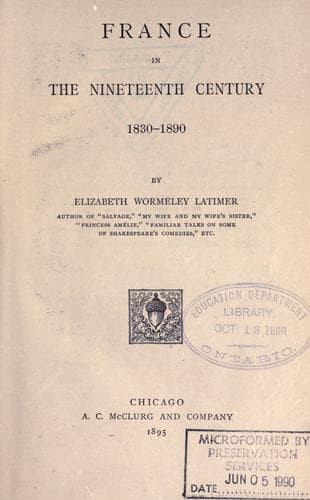
France in the Nineteenth CenturyLatimer, Elizabeth Wormeley
History
France in the Nineteenth Century
Latimer, Elizabeth Wormeley
France -- History -- 1789-1900
The Legislative Assembly held a midnight session; but nothing was
determined on until the morning, when the Empire was voted out,
and a Republic voted in.
It was a beautiful Sunday morning. Every Parisian was in the street,
and, wonderful to say, all faces seemed to express satisfaction. The
loss of an army, the surrender of the emperor, the national disgrace,
the prospect of a siege, the advance of the Prussians,--were things
apparently forgotten. Paris was charmed to have got rid of so unlucky
a ruler,--the emperor for whom more than seven millions of Frenchmen
had passed a vote of confidence a few months before. He seemed to
have no longer a single friend, or rather he had _one:_ in the
Assembly an elderly deputy stood up in his place and boldly said that
he had taken an oath to be faithful to the Emperor Napoleon, and
did not think himself absolved from it by his misfortunes.
[Illustration: _JULES SIMON._]
It was almost in a moment, almost without a breath of opposition,
that on the morning of Sept. 5, 1870, the Empire was voted at an
end, and a Republic put in its place. The duty of governing was
at once confided to seven men, called the Committee of Defence. Of
these, Arago, Crémieux, and Gamier-Pagès had been members of the
Provisional Government in 1848, while Léon Gambetta, Jules Favre,
Jules Ferry, and Jules Simon afterwards distinguished themselves.
Rochefort, the insurrectionist, made but one step from prison to
the council board, and was admitted among the new rulers. But the
two chief men in the Committee of Defence were Jules Favre and
Gambetta.
Gambetta, who before that time had been little known, was from
the South of France, and of Italian origin. He was a man full of
enthusiasm, vehement, irascible, and impulsive. The day came when
these qualities, tempered and refined, did good service to France,
when he also proved himself one of those great men in history who
are capable of supreme self-sacrifice. At present he was untried.
Jules Favre was respected for his unstained reputation and perfect
integrity, his disinterestedness and civic virtues, as also for
his fluency of speech. In person he was a small, thin man, with
a head that was said to resemble the popular portraits of General
Jackson.
General Jules Trochu, who was confirmed as military commander of
Paris, had written a book, previous to the war, regarding the
inefficiency of the French army; he had been therefore no favorite
with the emperor. His chief defect, it was said, was that he talked
so well that he was fond of talking, and too readily admitted many
to his confidence.
The Council of Regency had in the night melted away. A mob was
surging round the Tuileries. Where had the empress-regent fled?
Public-domain text, read in full here on John Shaqi.
Reviews
Reviews
No reviews yet
Be the first to share your thoughts on this work.
Elsewhere in the archive
Join the Discussion
Join the discussion
Sign in to leave a comment or review.
Sign InorCreate an account