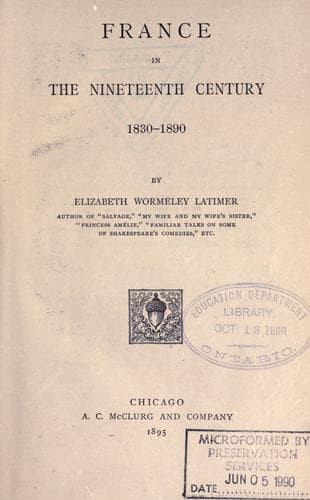
France in the Nineteenth CenturyLatimer, Elizabeth Wormeley
History
France in the Nineteenth Century
Latimer, Elizabeth Wormeley
France -- History -- 1789-1900
There were two English yachts lying at Deauville. On board of one
of these Dr. Evans went. It belonged to Sir John Burgoyne, grandson
of the General Burgoyne who surrendered at Saratoga. Sir John,
with his wife, was on a pleasure cruise. His yacht, the "Gazelle,"
was very small, only forty-five tons' burden, and carried a crew
of six men.
As soon as Sir John Burgoyne had satisfied himself that it was
really the empress who was thus thrown on his protection, he placed
himself and his yacht at her disposal, insisting, however, that she
must not come on board till nearly midnight, when he would meet
her on the _quai_. It was fortunate that he made this arrangement,
for, after dark, a police agent and a Russian spy came on board
and searched every corner of the little vessel. When at last they
departed, Sir John went on to the _quai_, and shortly afterwards
met two ladies, and a gentleman who carried a hand-bag. One of the
ladies stepped up to him and said, "I believe you are the English
gentleman who will take me to England. I am the empress." She then
burst into tears. On reaching the yacht, her first eager demand
was for newspapers. Happily Lady Burgoyne could tell her that the
Prince Imperial was safe in England; from the English papers she also
learned particulars of the disaster at Sedan, of the proclamation of
the Republic in the Corps Législatif at Paris, and of the treatment
of the emperor.
It was an anxious time for all on board the "Gazelle," for the
tide would not serve to leave the harbor till seven o'clock the
next morning, and Deauville was wildly riotous all night. At last
they worked out of the harbor and were at sea; but a tempest was
raging in the Channel, and so violent was it that at half-past one
the next morning the great English ironclad "Captain," commanded
by Sir Hugh Burgoyne, Sir John's cousin, went down, with all on
board, not far from where the little "Gazelle" was battling with
the gale. The "Gazelle" had a terrible passage, shipping tremendous
seas. She danced and rolled like a cork; but the ladies were brave,
and were encouraged by Lady Burgoyne's composure. "There was no
affectation of courage in Lady Burgoyne," said the empress afterwards;
"she simply acted as if nothing were the matter."
After about eighteen hours of this stormy passage the "Gazelle"
was safe at anchor off Ryde, in the Isle of Wight. The empress was
anxious that no one should know she was in England; but Sir John
told her it was his duty to inform the Foreign Office immediately.
An answer was at once returned by Lord Granville, assuring the
empress of welcome and protection; but he added in a postscript
to Sir John: "Don't you think you may have been imposed upon?"
The fact was that the Foreign Office had already received news
of the escape of the empress by way of Ostend, under the charge
of two English gentlemen, who had been themselves deceived. The
ladies they had assisted to leave Paris were Princess Clotilde
and an attendant.
Public-domain text, read in full here on John Shaqi.
Reviews
Reviews
No reviews yet
Be the first to share your thoughts on this work.
Elsewhere in the archive
Join the Discussion
Join the discussion
Sign in to leave a comment or review.
Sign InorCreate an account