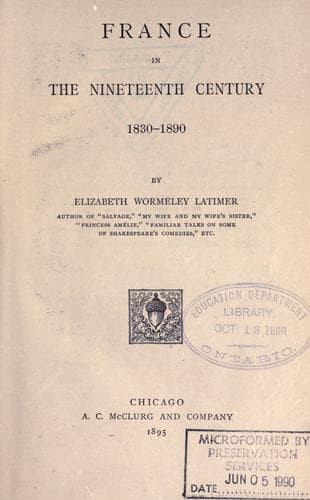
France in the Nineteenth CenturyLatimer, Elizabeth Wormeley
History
France in the Nineteenth Century
Latimer, Elizabeth Wormeley
France -- History -- 1789-1900
"The party of the Commune," says M. de Sarcey, "was composed partly
of charlatans, partly of dupes,--that is, the real members of the
Commune as a party. The rank and file were simply roughs, ready
for any mischief, and, we may add, for any plunder."
On the morning of October 31, a great crowd of these men assembled
before the Hôtel-de-Ville, then the seat of government. General
Trochu, Jules Favre, the Maire of Paris, and even Rochefort, who
was a member of the Committee of Defence, harangued them for hours
without producing any impression. The days were passed when the
mob of Paris could be controlled by a harangue. Finally, the crowd
made its way into the Hôtel-de-Ville, and endeavored to force the
Committee of Defence to issue a proclamation which would convene the
citizens to vote for a commune. The windows of the Hôtel-de-Ville
were flung open, in spite of the efforts of the members of the
Government, and lists of the proposed Communistic rulers were flung
out to the mob.
Meantime the members of the existing Government were imprisoned in
their council chamber, and threatened by armed men. Jules Favre sat
quietly in his chair; Jules Simon sketched upon his blotting-paper;
rifles were pointed at General Trochu. "Escape, General!" cried
some one in the crowd. "I am a soldier, Citizen," he answered,
"and my duty is to die at my post." One member of the Committee
managed, however to escape, and summoned the National Guard to
the assistance of his colleagues.
It was eight o'clock in the evening when the troops arrived. At
sight of their guns and bayonets the populace, grown weary of its
day's excitement, melted away. Before daylight, order was restored.
"Thus," says an American then in Paris, "in twelve hours Paris
had one Republican Government taken prisoner, another set up, and
the first restored."
So peace, after a fashion, returned; but Count Bismarck, learning
of these events, was strengthened in his determination to keep
Paris shut up within her gates till the factions in the city, in
the coming days of famine and distress, should destroy one another.
M. Thiers had almost concluded an agreement for an armistice of
thirty days, during which Paris was to be fed, while an election
should be held all over France for a National Assembly; but after
the disorders of October 31, Count Bismarck refused to hear of
any food being supplied to Paris, negotiations were broken off,
and the war went on.
Up to this time bread in Paris had been sufficient for its needs,
and not too dear. Wine was plenty, but meat was growing scarce.
Horses were requisitioned for food. It was the upper classes who
ate horse-flesh and queer animals out of the Jardin des Plantes;
the working-classes would not touch such things till driven to
eat them by absolute famine.
Public-domain text, read in full here on John Shaqi.
Reviews
Reviews
No reviews yet
Be the first to share your thoughts on this work.
Elsewhere in the archive
Join the Discussion
Join the discussion
Sign in to leave a comment or review.
Sign InorCreate an account