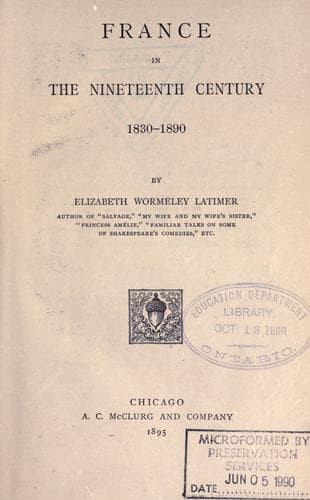
France in the Nineteenth CenturyLatimer, Elizabeth Wormeley
History
France in the Nineteenth Century
Latimer, Elizabeth Wormeley
France -- History -- 1789-1900
On November 28, however, the sortie was made; and had the expected
army been at hand, it might have been successful. The Parisians
crossed the Marne, and fought the Prussians so desperately that in
two days they had lost more men than in the battles at Gravelotte.
But on the third day an order was given to return to Paris; the
Government had received reliable information that the Army of the
Loire (under Aurelles des Paladines) had met with a reverse, and
would form no junction with the Parisian forces.
By the end of November cannon had been cast in the beleaguered city,
paid for, not by the Government, but by individual subscription.
These guns were subsequently to playa tragic part in the history
of the city. Some carried farther than the Prussian guns. All of
them had names. The favorite was called Josephine, and was a great
pet with the people.
Christmas Day of that sad year arrived at last, and New Year's
Day, the great and joyful fête-day in all French families. A few
confectioners kept their stores open, and a few boxes of bonbons
were sold; but presents of potatoes, or small packages of coffee,
were by this time more acceptable gifts. Nothing was plenty in
Paris but champagne and Colman's mustard. The rows upon rows of the
last-named article in the otherwise empty windows of the grocers
reminded Englishmen and Americans of Grumio's cruel offer to poor
Katherine of the mustard without the beef, since she could not
have the beef with the mustard.
Here is the bill-of-fare of a dinner given at a French restaurant
upon that Christmas Day:--
Soup from horse meat.
Mince of cat.
Shoulder of dog with tomato sauce.
Jugged cat with mushrooms.
Roast donkey and potatoes.
Rat, peas, and celery.
Mice on toast.
Plum pudding.
One remarkable feature of the siege was that everybody's appetite
increased enormously. Thinking about food stimulated the craving
for it, and by New Year's Day there were serious apprehensions of
famine. The reckless waste of bread and breadstuffs in the earlier
days of the siege was now repented of. Flour had to be eked out with
all sorts of things, and the bread eaten during the last weeks of the
siege was a black and sticky mixture made up of almost anything but
flour. All Paris was rationed. Poor mothers, leaving sick children
at home, stood for hours in the streets, in the bitter cold, to
obtain a ration of horseflesh, or a few ounces of this unnutritious
bread.
After news came of the retreat of the Army of the Loire, great
discouragement crept over the garrison. The Mobiles from the country,
who had never expected to be shut up in Paris for months, began to
pine for their families and villages. What might not be happening
to them? and they far away!
Public-domain text, read in full here on John Shaqi.
Reviews
Reviews
No reviews yet
Be the first to share your thoughts on this work.
Elsewhere in the archive
Join the Discussion
Join the discussion
Sign in to leave a comment or review.
Sign InorCreate an account