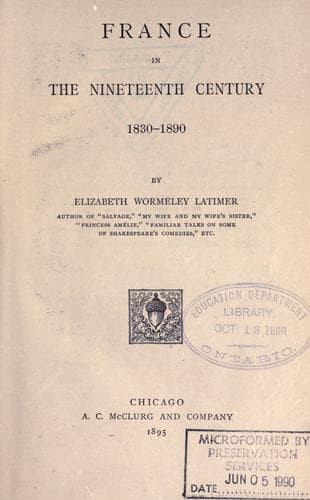
France in the Nineteenth CenturyLatimer, Elizabeth Wormeley
History
France in the Nineteenth Century
Latimer, Elizabeth Wormeley
France -- History -- 1789-1900
But tremendous as the bombardment was (sometimes a shell every two
minutes), it is astonishing how little real damage it did to the
city. The streets were wide, the open spaces numerous, the houses
solidly built, with large courtyards. In the middle of January,
when the extreme cold moderated, hundreds of people would assemble
in the Place de la Concorde, looking skyward. A black object would
appear, with a small bright spot in it, and making a graceful curve
in the air, with a whizzing, humming sound, would drop suddenly,
with a resounding boom, in some distant quarter in the city. Then
the spectators, greatly interested in the sight, waited for another.
The shells, which the Parisians called "obus," were like an
old-fashioned sugar-loaf, and weighed sometimes one hundred and
fifty pounds. But though, by reason of the great distance of the
Prussian batteries, the damage was by no means in proportion to
the number of shells sent into the city, many of them struck public
buildings, hospitals, and orphan asylums, in spite of the Red Cross
flags displayed above them.
By January 19, when the siege had lasted four months, and the
bombardment three weeks, the end seemed to be drawing near. Another
sortie was attempted; but there was a dense fog, the usual accompaniment
of a January thaw, and its only result was the loss of some very
valuable lives.
Then General Trochu asked for an armistice of two days to bury
the dead; but his real object was that Jules Favre might enter the
Prussian lines and endeavor to negotiate. Before this took place,
however, Trochu himself resigned his post as military governor. He
had sworn that under him Paris should never capitulate. General
Vinoy took his command.
The moment the Government of Defence was known to be in extreme
difficulty, the Communists issued proclamations and provoked risings.
The Hôtel-de-Ville was again attacked. In this rising famished
women took a prominent part. Twenty-six people were killed in the
_émeute_, and only twenty-eight by that day's bombardment.
On January 23 Jules Favre went out to Versailles. Paris was hushed.
It was not known that negotiations were going on, but all felt
that the end was near at hand. No one, dared to say the word
"capitulate," though some of the papers admitted that by February
3 there would not be a mouthful of bread in the city.
On January 27 the Parisians learned their fate. The following
announcement appeared in the official journal:
Public-domain text, read in full here on John Shaqi.
Reviews
Reviews
No reviews yet
Be the first to share your thoughts on this work.
Elsewhere in the archive
Join the Discussion
Join the discussion
Sign in to leave a comment or review.
Sign InorCreate an account