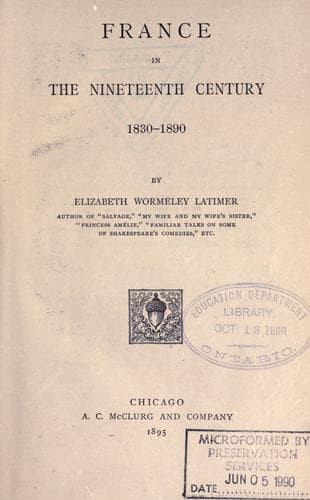
France in the Nineteenth CenturyLatimer, Elizabeth Wormeley
History
France in the Nineteenth Century
Latimer, Elizabeth Wormeley
France -- History -- 1789-1900
"They were small men. They had light hair, but were very thick-set.
They looked very tired, and were covered with dust and with torn
clothes: but they had good horses. They wore the Prussian helmet
and spike, and were well armed, with a sabre on one side and on
the other a huge horse-pistol two feet long, while they carried
carbines in their hands, all ready to shoot if occasion offered. But
all the French soldiers had left Versailles, except a few National
Guards. The inhabitants looked very sad; the women were crying,
and the men looked as if they would like to. We walked on, when
suddenly we saw a troop of horsemen come through an arch that spanned
one of the main roads; behind came more, and more, and more. The
first were fifty Uhlans. These fellows were in blue, on horseback,
very handsome. Then came some men with silver death's-heads and
crossbones on their caps; then hundreds and hundreds of mounted
fellows with needle-guns and sabres; then three regiments of infantry,
marching in superb time. Every five hundred men had a drum corps
and fifes playing in perfect unison. You could almost feel the
ground shake with the steady thud of their march as they tramped
on. The men looked dirty and tired, but were fat, and many of them
were laughing. Looking down the road as far as possible, we could
still see helmets, spikes, and guns all leaning exactly the same
way, and glittering in the sunshine. All the officers looked like
gentlemen, with great whiskers, and jolly, fat faces. None of the
men talked, much less sang, as the French do. When these had passed,
there came a splendid band of sixty pieces, playing beautifully,
and then regiment after regiment of cavalry (not carrying as much,
nearly, as the French cavalry do). Their horses were in excellent
order, many of them very handsome. Lots of the soldiers were smoking
great German pipes.
"This was the army of the Crown Prince, less than a third of those
that entered the city. They passed through Versailles, only stopping
to repair the roads torn up by the peasantry. Next came artillery
and baggage-wagons, and carts of ammunition; more infantry, more
bands, fifty pontoons on carts; more cavalry; then hundreds of
soldiers on peasants' carts, which they had requisitioned as they
passed through the country; then ambulances and carts, full of
wounded, who were brought to the Hôtel des Reservoirs and to the
Palace. They began to pass at half-past one, and were passing three
hours; and I saw just as many more going by another road, where
they passed till seven in the evening. There seemed, at times, to
be a hunting corps, for every man would have a fat hare or rabbit,
or hens, ducks, pheasants, or partridges slung on his back. One
man I saw with a live sheep, full grown, over his shoulders.
Public-domain text, read in full here on John Shaqi.
Reviews
Reviews
No reviews yet
Be the first to share your thoughts on this work.
Elsewhere in the archive
Join the Discussion
Join the discussion
Sign in to leave a comment or review.
Sign InorCreate an account