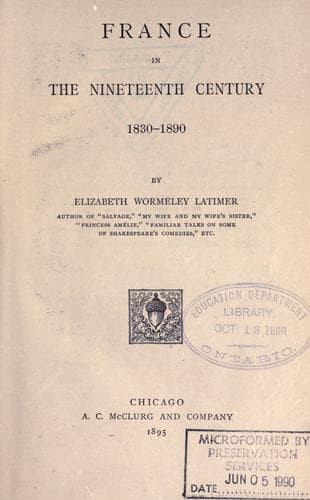
France in the Nineteenth CenturyLatimer, Elizabeth Wormeley
History
France in the Nineteenth Century
Latimer, Elizabeth Wormeley
France -- History -- 1789-1900
At the bridge of Courbevoie, near Neuilly, where the body of Napoleon
had been landed thirty years before, a flag of truce was met by
two National Guards. Its bearer was a distinguished surgeon, Dr.
Pasquier. After a brief parley, one of the National Guards blew
out the doctor's brains. When news of this outrage was brought to
General Vinoy, he commanded the guns of Fort Valérien to be turned
upon the city.
At five A. M. the next morning five columns of Federals marched out
to take the fort. They were under the command of three generals,
Bergeret, Duval, and Eudes. With Bergeret rode Lullier, who had
been a naval officer, and Flourens, the popular favorite among
the members of the Commune. The three divisions marched in full
confidence that the soldiers under Vinoy would fraternize with them.
They were wholly mistaken; the guns of Fort Valérien crashed into
the midst of their columns, and almost at the same time Flourens,
in a hand-to-hand struggle, was slain.
Flourens had begun life with every prospect of being a distinguished
scientist. His father had been perpetual secretary of the Academy
of Sciences and a professor in the Collège de France, in which
his son succeeded him when he was barely twenty-one. His first
lecture, on the "History of Man," created a great impression; but
in 1864 he resigned his professorship, and thenceforward devoted
all his energies to the cause of the oppressed. In Crete he fought
against the Turks. He was always conspiring when at home in Paris;
even when the Prussians were at its gates, he could not refrain.
He was the darling of the Belleville population, whom in times of
distress and trial he fed, clothed, and comforted. Sometimes he
was in prison, sometimes in exile. "He was a madman, but a hero,
and towards the poor and the afflicted as gentle as a sister of
charity," said one who knew him.
Of the three generals who led the attack on Mont Valérien, Duval
was captured and shot; Eudes and Bergeret got back to Paris in
safety. But the latter, in company with Lullier, was at once sent
to prison by the Central Committee, and a decree was issued that
Paris should be covered with barricades. As the insurgents had
plenty of leisure, these barricades were strong and symmetrical,
though many of them were injudiciously placed.
Whilst the fight of the 4th of April was going on without the gates,
the Central Committee was occupied in issuing decrees, by which
Thiers, Favre, Simon,--in short, all the legitimate ministers,--were
summoned to give themselves up to the Commune to be tried for their
offences, or else all their property in Paris would be confiscated
or destroyed.
Public-domain text, read in full here on John Shaqi.
Reviews
Reviews
No reviews yet
Be the first to share your thoughts on this work.
Elsewhere in the archive
Join the Discussion
Join the discussion
Sign in to leave a comment or review.
Sign InorCreate an account