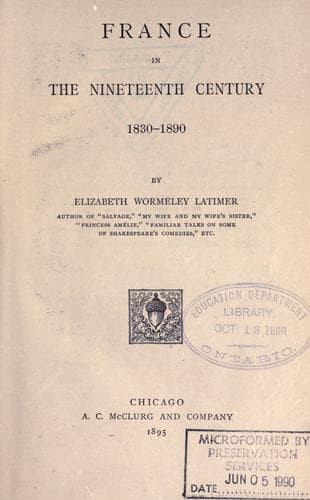
France in the Nineteenth CenturyLatimer, Elizabeth Wormeley
History
France in the Nineteenth Century
Latimer, Elizabeth Wormeley
France -- History -- 1789-1900
Reporters were not admitted, and spectators could be brought in only
by favor of some member. The members sat upon red-velvet chairs,
each girt with his red scarf of office, trimmed with heavy bullion
fringe. The chairs were placed round a long table, on which was
stationery for the members' use, _carafes_ of water, and sugar
for _eau sucrée_. It was an awe-inspiring assembly; "for the men
who talked, held a city of two millions of inhabitants in their
hands, and were free to put into practice any or all of the amazing
theories that might come into their heads. Their speeches, however,
were brief; they were not wordy, as they might have been if reporters
had been present. Most of them wore uniforms profusely decorated
with gold lace," and, says an Englishman who saw them in their
seats, "one had only to look in their faces to judge the whole
truth in connection with the Commune,--its causes, its prospects,
and its signification. A citizen whom I had heard of as most hotly
in favor of Press freedom, proposed in my hearing that all journals
in Paris should be suppressed save those that were edited by members
of the Council of the Commune. That there were three or four earnest
men among them, no one can dispute; but as to the rest, I can only
say that if they were zealous patriots devoted to their country's
good, they did not, when I saw them, look like it."[1]
[Footnote 1: Cornhill Magazine, 1871.]
In the first week of May the Commune decreed the destruction of
M. Thiers's beautiful home in the Rue St. Georges. The house was
filled with objects of art and with documents of historical interest
which he had gathered while writing his History of the Revolution,
the Consulate, and the First Empire.
The Commune had removed some of these precious things, and sold
them to dealers, from whom many were afterwards recovered; but
the mob which assembled to execute the decree of destruction, was
eager to consume everything that was left. In the courtyard were
scattered books and pictures waiting to feed the flames. "The men
busy at the work looked," says an Englishman,[2] "like demons in
the red flame. I turned away, thinking not of the man of politics,
but of the historian, of the house where he had thought and worked,
of the books that he had treasured on his shelves, of the favorite
chair that had been burned upon his hearthstone. I thought of all
the dumb witnesses of a long and laborious life dispersed, of all
the memories those rooms contained destroyed."
[Footnote 2: Leighton, Paris under the Commune.]
Public-domain text, read in full here on John Shaqi.
Reviews
Reviews
No reviews yet
Be the first to share your thoughts on this work.
Elsewhere in the archive
Join the Discussion
Join the discussion
Sign in to leave a comment or review.
Sign InorCreate an account