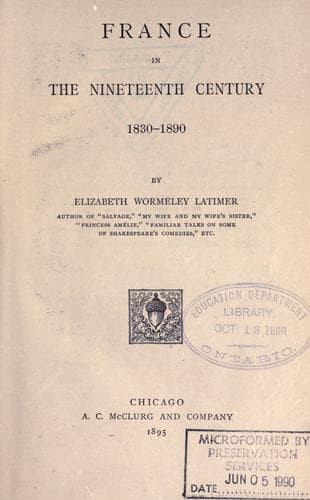
France in the Nineteenth CenturyLatimer, Elizabeth Wormeley
History
France in the Nineteenth Century
Latimer, Elizabeth Wormeley
France -- History -- 1789-1900
At one o'clock on the morning of April 6, three weeks after the
proclamation of the Commune, a body of the National Guard was drawn
up on the sidewalk in the neighborhood of the Madeleine. A door
suddenly opened and a man came hastily out, followed by two National
Guards shouting to their comrades. The man was arrested at once,
making no resistance. It was the Abbé Duguerry, _curé_ of the
Madeleine,[1]--the first of the so-called hostages arrested in
retaliation for the summary execution of General Duval, who had
commanded one of the three columns that marched out of Paris the
day before to attack the Versaillais.
[Footnote 1: _Curé_ in France means rector; what we mean by a curate
or assistant minister is there called _vicaire_.]
Both the _curé_ of the Madeleine and his _vicaire_, the Abbé Lamazou,
were that night arrested. The latter, who escaped death as a hostage,
published an account of his experiences; but he died not long after
of heart disease, brought on by his excitement and suffering during
the Commune.
The same night Monseigneur Darboy, the archbishop of Paris, his
chaplain, and eight other priests, were arrested. One was a missionary
just returned from China, another was the Abbé Crozes, the admirable
chaplain (_aumônier_) of the prison of La Roquette,--a man whose
deeds of charity would form a noble chapter of Christian biography.
When Archbishop Darboy was brought before the notorious "delegate,"
Raoul Rigault, he began to speak, saying, "My children--" "Citizen,"
interrupted Rigault, "you are not here before children,--we are
men!" This sally was heartily applauded in the publications of
the Commune.
As it would not be possible to sketch the lives and deaths of all
these victims of revolutionary violence, it may be well to select
the history of the youngest among them, Paul Seigneret.[1] His
father was a professor in the high school at Lyons. Paul was born
in 1845, and was therefore twenty-six years old when he met death,
as a hostage, at the hands of the Commune. His home had been a
happy and pious one, and he had a beloved brother Charles, to whom
he clung with the most tender devotion. Charles expected to be a
priest; Paul was destined for the army, but he earnestly wished
that he too might enter the ministry. Lamartine's "Jocelyn" had
made a deep impression on him, but his father having objected to
his reading it, he laid it aside unfinished; what he had read,
however, remained rooted in his memory.
[Footnote 1: Memoir of Paul Seigneret, abridged in the "Monthly
Packet."]
When Paul was eighteen, his father gave his sanction to his entering
the priesthood; he thought him too delicate, however, to lead the
life of a country pastor, and desired him, before he made up his
mind as to his vocation, to accept a position offered him as tutor
in a family in Brittany.
Public-domain text, read in full here on John Shaqi.
Reviews
Reviews
No reviews yet
Be the first to share your thoughts on this work.
Elsewhere in the archive
Join the Discussion
Join the discussion
Sign in to leave a comment or review.
Sign InorCreate an account