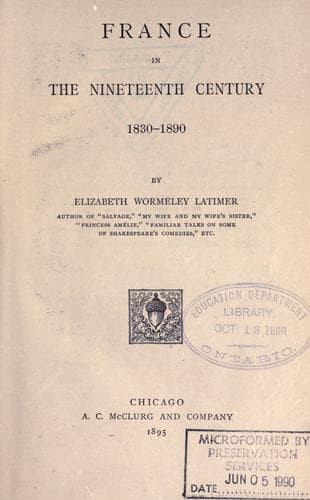
France in the Nineteenth CenturyLatimer, Elizabeth Wormeley
History
France in the Nineteenth Century
Latimer, Elizabeth Wormeley
France -- History -- 1789-1900
At six in the morning of May 24th,[1] a second order came to the
director of the prison to deliver up all hostages in his hands. He
remonstrated, saying he could not act upon an order to deliver up
prisoners who were not named. Finally, a compromise was effected;
six were to be chosen. The commander of the firing party asked for
the prison register. The names of the hostages were not there.
Then the list from Mazas was demanded. The director could not find
it. At last, after long searching, they discovered it themselves.
Genton, the man in command, sat down to pick out his six victims.
He wrote Darboy, Bonjean, Jecker, Allard, Clerc, Ducoudray. Then
he paused, rubbed out Jecker, and put in Duguerrey. Darboy, as we
know, was the archbishop; Bonjean, judge of the Court of Appeals;
Allard, head-chaplain to the hospitals, who had been unwearied
in his services to the wounded; Clerc and Ducoudray were Jesuit
fathers; Duguerrey was pastor of the Madeleine. Jecker was a banker
who had negotiated Mexican loans for the Government. The next day
the Commune made a present of him to Genton, who, after trying
in vain to get a few hundred thousand francs out of him for his
ransom, shot him, assisted by four others, one of whom was Ferré,
and flung his body into the cellar of a half-built house upon the
heights of Belleville.
[Footnote 1: Macmillan's Magazine, 1873.]
When the order drawn up by Genton had been approved at headquarters,
the director of the prison had no resource but to deliver up his
prisoners.
Another man, wearing a scarf of office, had now joined the party.
He was very impatient, and accused the others roundly of a want
of revolutionary spirit. He landed afterwards in New York, where
his fellow-Communists gave him a public reception.
One of the warders of the prison, Henrion by name, made some attempt
to expostulate with the _Vengeurs de Flourens_, who had been told off
for the execution. "What would you have?" was the answer. "Killing is
not at all amusing. We were killing this morning at the Prefecture
of Police. But they say this is reprisal. The Versaillais have
been killing our generals."
Soon Henrion was called upon to open the fourth corridor. "I must
go and get the keys," he answered. He had them in his hand at the
moment. He went rapidly away, flung the keys into a heap of filth,
and rushed out of the prison. By means of a twenty-franc gold piece
that he had with him, he passed out of the gates of Paris, and
sought refuge with the Bavarians at Vincennes.
Meantime another bunch of keys was found, and the executioners,
led by Ferré, Lolive, and Mégy,--that member of the Commune whom
none of them seemed to know,--hurried upstairs. In the crowd were
_gamins_ and women, National Guards, Garibaldians, and others, but
chiefly the _Vengeurs de Flourens_, a corps of which an Englishman
who served the Commune said: "They were to a man all blackguards."
Public-domain text, read in full here on John Shaqi.
Reviews
Reviews
No reviews yet
Be the first to share your thoughts on this work.
Elsewhere in the archive
Join the Discussion
Join the discussion
Sign in to leave a comment or review.
Sign InorCreate an account