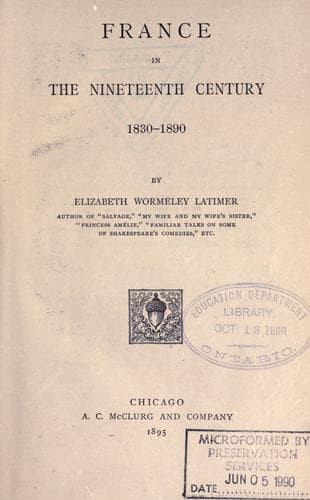
France in the Nineteenth CenturyLatimer, Elizabeth Wormeley
History
France in the Nineteenth Century
Latimer, Elizabeth Wormeley
France -- History -- 1789-1900
Monday, May 29, found the city in the hands of the Versaillais.
The Provisional Government and its Parliament were victorious. The
army, defeated at Sedan, had conquered its insurgent countrymen.
All that remained of the Commune was wreck and devastation. The
Tuileries, the Column of the Place Vendôme, the Treasury, the Palace
of the Legion of Honor, and the Hôtel-de-Ville, or City Hall, were
destroyed, besides two theatres, the Law Courts, or Palais de Justice,
the offices of the Council of State and the Court of Accounts,
the State Safe Deposit (Caisse des Dépôts et de Consignations),
the Library of the Louvre, the manufactory of Gobelin's tapestry,
the Prefecture of Police, eight whole streets, and innumerable
scattered private houses. The vengeance of the soldiers as they
made their way from street to street, from barricade to barricade,
was savage and indiscriminate. Every man arrested whose hands were
black with powder was carried to a street corner or a courtyard,
and summarily shot. Of course many wholly innocent persons perished,
for the troops of the Commune had been of two kinds,--the National
Guard and the Volunteers. Most of the latter were devils incarnate.
Among them were the _Vengeurs de Flourens_, who were foremost in
executions, and bands called by such names as _Les Enfants du Père
Duchêne_ and _Les Enfants Perdus_. The National Guards were of
three classes,--genuine Communists, workmen whose pay was their
only resource for the support of their families, and pressed men,
forced to fight, of whom there were a great many.
I have before me three narratives written by gentlemen who either
suffered or participated in the Great Revenge. One was a resident
in Paris who had taken no part either for or against the Commune;
one had served it on compulsion as a soldier; and one was an officer
of the Versailles army, who on May 21 led his troops through a breach
into the city, and fought on till May 27, when all was over.
It seems to me that such accounts of personal experience in troubled
times give a far more vivid picture of events than a mere formal
narration. I therefore quote them in this chapter in preference
to telling the story in my own words.
The first is by Count Joseph Orsi,[1] whose visit to Raoul Rigault's
office at the Prefecture of Police has already been told. He was
left unmolested by the Commune, most probably because in early
life he had been a member of those secret societies in Italy to
which Louis Napoleon himself belonged. He says,--
[Footnote 1: Published in Fraser's Magazine, 1879.]
Public-domain text, read in full here on John Shaqi.
Reviews
Reviews
No reviews yet
Be the first to share your thoughts on this work.
Elsewhere in the archive
Join the Discussion
Join the discussion
Sign in to leave a comment or review.
Sign InorCreate an account