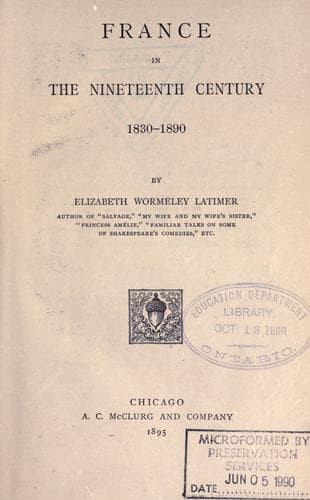
France in the Nineteenth CenturyLatimer, Elizabeth Wormeley
History
France in the Nineteenth Century
Latimer, Elizabeth Wormeley
France -- History -- 1789-1900
By an accident he became acquainted before other Parisian journalists
with the signing of the Ordinances by Charles X., July 26, 1830.
He had also good reason to think that Louis Philippe, if offered
the crown of France or the lieutenant-generalship of the kingdom,
would accept it. While fighting was going on in Paris, he and Ary
Scheffer, the artist, were the two persons deputed to go to Neuilly
and sound the Duke of Orleans. As we have seen, Marie Amélie, the
duke's wife, indignantly refused their overtures in the absence of
her husband, while Madame Adélaïde, his sister, encouraged them.
Thiers, Laffitte, and Lafayette became the foremost men in Paris
at this crisis, and at the end of some days Louis Philippe became
king of the French. He wanted to make Thiers one of his ministers,
but Thiers characteristically declined so high an office until
he should have served an apprenticeship to ministerial work in
an under secretary-ship, and knew the machinery and the working
of all departments of government.
Thus far I have not spoken of Thiers' "History of the Revolution."
It appeared first in monthly parts. Up to the publication of the
first number, in 1823, no writer in France had dared to speak well
of any actor in the Revolution. Thiers' History, as it became known,
created a great sensation. Thiers himself was supposed by the general
public (both of his own country and of foreign nations) to be a
wild revolutionist. At first the critics knew not how to speak of a
book that admired the States-General and defended the Constitutional
Convention; but by the time the third volume was completed, in 1827,
it was bought up eagerly. The work was published afterwards in
ten volumes, and the "History of the Consulate and Empire," which
appeared between 1845 and 1861, is in twenty volumes; but it is
only fair to say that the print is very large and the illustrations
are very numerous, and that the portraits especially are beyond
all praise.
From 1831 to 1836, Thiers was one of Louis Philippe's ministers,
and from 1836 to 1840 he was Prime Minister, or President of the
Council.
As soon as Thiers rose to power his mercurial father made his appearance
in Paris. Thiers was disposed to receive him very coldly. "What have
you ever done for me that you have any claim on me?" he asked. "My
son," replied the prodigal parent, "if I had been an ordinary father
and had stayed by my family and brought up a houseful of children in
obscurity, do you suppose you would have been where you are now?"
At this Thiers laughed, and gave his father a post-mastership in
a small town in the South of France called Carpentras. There the
old gentleman lived, disreputable and extravagant to the last,
surrounded by a large family of dogs.
Public-domain text, read in full here on John Shaqi.
Reviews
Reviews
No reviews yet
Be the first to share your thoughts on this work.
Elsewhere in the archive
Join the Discussion
Join the discussion
Sign in to leave a comment or review.
Sign InorCreate an account