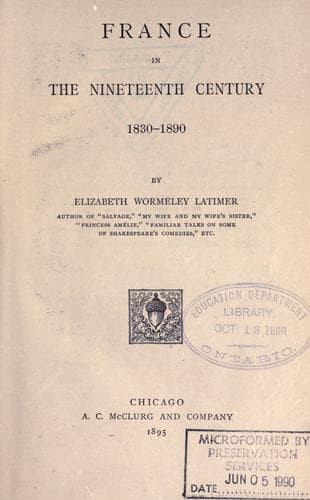
France in the Nineteenth CenturyLatimer, Elizabeth Wormeley
History
France in the Nineteenth Century
Latimer, Elizabeth Wormeley
France -- History -- 1789-1900
The duke afterwards prepared for and entered the Polytechnic, which
is said to demand more hard study than any other school in the world.
He made his first campaign in Africa in 1835, and afterwards served
with distinction in the early part of that one which resulted in
the retreat from Constantine; but before Constantine was reached,
a severe illness invalided him. He was a liberal in politics, the
sincere friend of the working-classes, and was on intimate terms
with men of letters, even with Victor Hugo, in spite of his advanced
opinions. He was a patron of art and artists. Some beautiful
table-pieces that he had ordered, by Barye, are now in the gallery
of Mr. W. S. Walters, of Baltimore, they not having been completed
when he died. His wife charmed every one by her good sense, grace,
and goodness. They had had four years of happy married life, and
had two little sons, when, in July, 1842, the duchess went for
her health to the baths of Plombières, in the mountains of the
Vosges. Her husband escorted her thither, and then returned to
Paris, on his way to attend some military manoeuvres near Boulogne.
As he was driving out to Neuilly to make his _adieux_ to his family,
the horses of his carriage were startled by an organ-grinder on the
Avenue de Neuilly. The duke, who was alone, tried apparently to
jump out of the carriage. Had he remained seated, all would have
been well. He fell on his head on the _pavé_ of the broad avenue,
breaking the vertebral column.
He was carried into a small grocer's shop by the way-side, where
afterwards a little chapel was erected by his family. Messengers
were sent to the Château de Neuilly, and his father, mother, and
sisters, without bonnets or hats, came rushing to the spot. He
lived, unconscious, for four hours. A messenger was despatched
at once to bring his wife from Plombières. She had just finished
dressing for dinner, in full toilet, when the news reached her.
Without changing her dress, she started instantly for Paris, but
when she reached it, her husband was in his coffin.
When his will was opened, it was found to contain an earnest exhortation
to his son that, whether he proved "one of those tools that Heaven
fits for work, but does not use," or ascended the French throne,
he "should always hold in his heart, above all things, love to
France, and fidelity to the principles of the French Revolution."
Here is the poor Queen Amélie's account of the death of her son,
written to a dear friend four days after:--
Public-domain text, read in full here on John Shaqi.
Reviews
Reviews
No reviews yet
Be the first to share your thoughts on this work.
Elsewhere in the archive
Join the Discussion
Join the discussion
Sign in to leave a comment or review.
Sign InorCreate an account