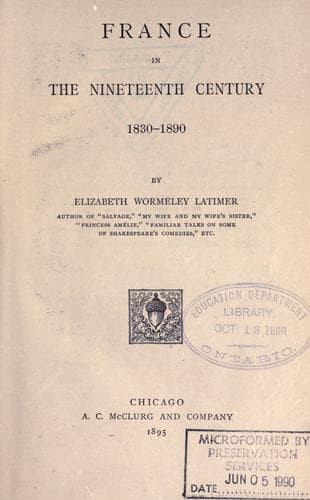
France in the Nineteenth CenturyLatimer, Elizabeth Wormeley
History
France in the Nineteenth Century
Latimer, Elizabeth Wormeley
France -- History -- 1789-1900
When this was done there could be no more doubt. Three fancy daggers
were found, one of which had always hung in the chamber of the
duchess. All of them were stained with blood. The duke had changed
his clothes, and had tried to wash those he took off in the pail
whose bloody water he had thrown away. Subsequently it was conjectured
that his purpose had been to stab his wife in her sleep, and then
by a strong pull to bring down upon her the heavy canopy. The bolt
he had unscrewed permitted him at dead of night quietly to enter
her chamber.
The police were puzzled as to how they ought to treat the murderer.
As he was a peer of France, they could not legally arrest him without
authority from the Chamber of peers, or from the king. The royal
family was at Dreux. The king was appealed to at once, and immediately
gave orders to arrest the duke and to summon the peers for his
trial. But meantime the duke, who had been guarded by the police
in his own chamber, had contrived to take poison. He took such
a quantity of arsenic that his stomach rejected it. He did not
die at once, but lingered several days, and was carried to prison
at the Luxembourg, where the poison killed him by inches. He died
untried, having made no confession.
His son, who was very young at the time of his parents' death,
married an American lady when he grew to manhood. It was a long
courtship, for the young duke's income went largely to keep in
repair his famous Château de Vaux, where Fouquet had entertained
Louis XIV. with regal magnificence. Finally a purchaser was found
for the ancestral seat; and relieved of the obligations it involved,
the duke married, and retired to his estates in Corsica.
As to Mademoiselle de Luzy, she was tried for complicity in the
murder of the duchess, and acquitted. There was no evidence whatever
against her. But popular feeling concerning her as the inciting
cause of the poor duchess's death was so strong that by the advice
of her pastor--the Protestant M. Coquerel--she changed her name and
came to America. She brought letters of introduction to a family
in Boston, who procured her a situation as governess in Connecticut.
There she soon after married a Congregational minister.
It seems hard to imagine how such a tragedy could have borne its
part among the causes of Louis Philippe's downfall; but those who
look into Alison or Lamartine will see it set down as one of the
events which greatly assisted in bringing about the revolution of
February. Mobs, like women, are often swayed by persons rather
than by principles.
It was believed by the populace that court favor had prevented
the duke from going to prison like any common criminal, and that
the same influence had procured him the poison by which he escaped
a public execution.
CHAPTER VI.
THE DOWNFALL OF LOUIS PHILIPPE.
Public-domain text, read in full here on John Shaqi.
Reviews
Reviews
No reviews yet
Be the first to share your thoughts on this work.
Elsewhere in the archive
Join the Discussion
Join the discussion
Sign in to leave a comment or review.
Sign InorCreate an account