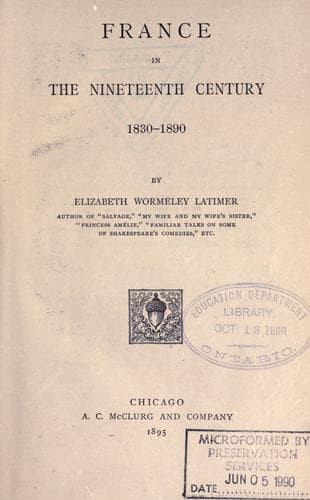
France in the Nineteenth CenturyLatimer, Elizabeth Wormeley
History
France in the Nineteenth Century
Latimer, Elizabeth Wormeley
France -- History -- 1789-1900
When morning dawned, a proclamation, forbidding the banquet, was
posted on every street-corner. The soldiers were everywhere confined
to their quarters, the windows of which were stuffed with mattresses;
but to residents in Paris the day seemed to pass quietly, though
about noon the Place de la Madeleine was full of men surrounding
the house of Odillon Barrot, the chief leader of the opposition,
demanding what, under the circumstances, they had better do. In the
Place de la Concorde, troops were endeavoring to prevent the crowd
from crossing the Seine and assembling in front of the Chamber of
Deputies. In order to break up the throng upon the bridge, a heavy
wagon was driven over it at a rapid pace, escorted by soldiers, who
slashed about them with their sheathed swords. At the residence
of M. Guizot, then both Prime Minister and Minister for Foreign
Affairs, a large crowd had assembled and had broken his windows;
but the rioters were dispersed the Municipal Guard and the Police.
In the afternoon, on the Place de la Concorde, a party of men and
boys, apparently without leaders, contrived to break through the
troops guarding the bridge, and began to ascend the steps of the
Chamber of Deputies. Being refused admission to the hall, they
proceeded to break windows and do other damage. Then a party of
dragoons began to clear the bridge, but good-humoredly, and the
people were retiring as fast as they might, when a detachment of the
Municipal Guard arrived. The Municipal Guard was a handsome corps
of mounted police, the men being all stalwart and fine-looking. They
wore brazen helmets and horse-tails and glittering breastplates,
but they were very unpopular, while the National Guards were looked
on by the rioters as their supporters. The Municipal Guards, when
they came upon the bridge, began treating the crowd roughly, a
good many persons were hurt, and an old woman was trodden down. At
this the crowd grew furious, stones were thrown, and the soldiers
drew their swords. Before nightfall there was riot and disorder all
over Paris. Towards dusk the _rappel_--the signal for the National
Guard to muster--had been beaten in the streets, and soon many
soldiers of that body might be seen, escorted by men in blouses
carrying their guns, while the National Guards, unarmed, were shouting
and singing.
All Tuesday, February 22, the affair was a mere riot. But during
the night the secret societies met, and decided on more formidable
action.
The next morning was chilly and rainy, very dispiriting to the
troops, who had bivouacked all night in the public squares, where
they had been ill-provided with food and forage. The coats and
swords of the students at the Polytechnic had been removed during
the night, to prevent their joining the bands who were singing the
"Marseillaise" and the "Dernier Chant des Girondins" under their
windows.
Public-domain text, read in full here on John Shaqi.
Reviews
Reviews
No reviews yet
Be the first to share your thoughts on this work.
Elsewhere in the archive
Join the Discussion
Join the discussion
Sign in to leave a comment or review.
Sign InorCreate an account