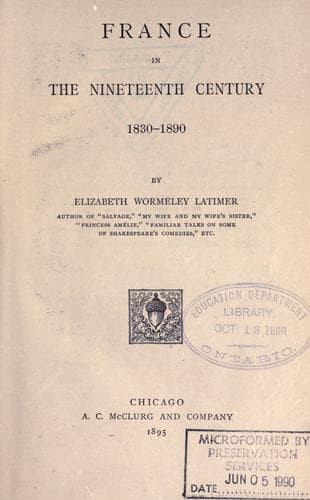
France in the Nineteenth CenturyLatimer, Elizabeth Wormeley
History
France in the Nineteenth Century
Latimer, Elizabeth Wormeley
France -- History -- 1789-1900
Marshal Bugeaud found everything in wild confusion at the War Office;
but was restoring order, and had marched four columns of troops
through Paris without serious opposition, when he received orders
from M. Thiers that not another shot was to be fired by the soldiers.
The marshal replied that he would not obey such orders unless he
received them from the king. The Duc de Nemours therefore signed
the paper in the name of his father, and soon afterwards a new
proclamation was posted on the walls:--
Citizens! An order has been given to suspend all firing. We are
charged by the king to form a ministry. The Chamber is about to be
dissolved. General Lamoricière has been appointed Commander-in-Chief
of the National Guard. Messieurs Odillon Barrot, Thiers, Lamoricière,
and Duvergier de Haurannes are ministers. Our watchwords are,--Order,
Union, Reform!
(Signed) ODILLON BARROT.
THIERS.
This proclamation may be said to have been the beginning of the
end. The soldiers were disgusted; supporters of the monarchy lost
heart; the secret societies now felt that the game was in their
hands. By that time barricades without number, it was said, had
been thrown up in the streets. The suburbs of Paris were cut off
from the capital. During the previous night, arms had been everywhere
demanded from private houses; but in obtaining them the insurgents
endeavored to inspire no unnecessary terror. One lady in the English
quarter was found kneeling by the bedside of her dying child. When
a party of armed men entered the chamber they knelt down, joined
their prayers to hers for the soul that was departing, and then
quitted the room in silence, placing a guard and writing over the
door in chalk: "Respect this house, for death is here."
By nine o'clock on Wednesday morning the troops, disgusted by the
order which forbade them to defend themselves, reversed their arms
and fraternized with the people, the officers sheathing their swords.
A little later, Odillon Barrot, who supposed himself to be the
people's favorite, rode along the Boulevard to proclaim to the
rioters that he was now their minister, and that the cause of reform
was assured. He was met with cries of "Never mind him! We have no
time to hear him! Too late, too late! We know all he has to say!"
About the same time the École Militaire was taken; but a guard
_en blouse_ was posted to protect the apartments of the ladies
of the governor. The fight before the Palais Royal occurred about
noon. The palace, which was the private property of Louis Philippe,
was sacked, and many valuable works of art were destroyed.
Public-domain text, read in full here on John Shaqi.
Reviews
Reviews
No reviews yet
Be the first to share your thoughts on this work.
Elsewhere in the archive
Join the Discussion
Join the discussion
Sign in to leave a comment or review.
Sign InorCreate an account