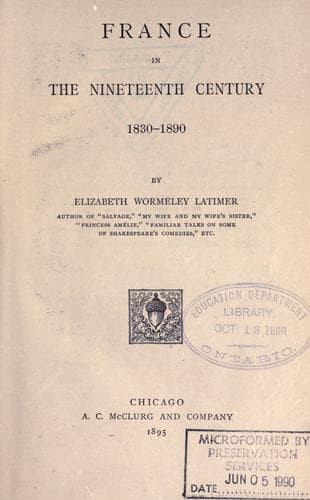
France in the Nineteenth CenturyLatimer, Elizabeth Wormeley
History
France in the Nineteenth Century
Latimer, Elizabeth Wormeley
France -- History -- 1789-1900
At first the crowd injured nothing, even the king's portraits being
respected; but after a while the destruction of state furniture
began. Three men were seen smoking in the state bed; some ate up
the royal breakfast; and the cigars of the princes were freely
handed to rough men in the crowd.
Meantime in the Chamber of Deputies the scene was terrible. M.
Dupin, its president, lost his head. Had he, when he knew of the
king's abdication, declared the sitting closed, and directed the
Deputies to disperse, he might possibly have saved the monarchy.
But the mob got possession of the _tribune_ (the pulpit from which
alone speeches can be made in the Chamber); they pointed their guns
at the Deputies, who cowered under their benches, and the last
chance for Louis Philippe's dynasty was over. Odillon Barrot, who
had come down to the house full of self-importance, notwithstanding
his reception on the Boulevards, found that his hour was over and
his power gone.
M. de Lamartine was the idol of the mob, though he was very nearly
shot in the confusion. Armed insurgents crowded round him, clinging
to his skirts, his hands, his knees. Throughout the tumult the
reporters for the "Moniteur" kept their seats, taking notes of what
was passing.
The Duchess of Orleans found the Chamber occupied by armed men. She
was jostled and pressed upon. A feeble effort was made to proclaim
her son king, and to appoint her regent during his minority. She
endeavored several times to speak, and behaved with an intrepidity
which did her honor. But when Lamartine, mounting the tribune,
cast aside her claims, and announced that the moment had arrived
for proclaiming a provisional government and a republic, she was
hustled and pushed aside by the crowd.
She was dressed in deep mourning. Her long black veil, partly raised,
showed her fair face marred with sorrow and anxiety. Her children
were dressed in little black velvet skirts and jackets, with large
white turned-down collars. Soon the crowd around the tribune, beneath
which the duchess had her seat, grew so furious that her attendants,
fearing for her life, hurried her away.
In the press and the confusion the Duc de Nemours and her two children
were parted from her. The Comte de Paris was seized by a gigantic
man _en blouse_, who said afterwards that he had been only anxious
to protect the child; but a National Guard forced the boy from his
grasp, and restored him to his mother. The Duc de Chartres was
for some time lost, and was in great danger, having been knocked
down on the staircase by an ascending crowd.
At last, however, the little party, under the escort of the Duc
de Nemours, who had disguised himself, escaped on foot into the
streets, then growing dark; and finding a hackney-coach, persuaded
the coachman to drive them to a place of safety. The Duc de Chartres
was not to be found, and his mother passed many hours of terrible
anxiety before he was restored to her arms.
Public-domain text, read in full here on John Shaqi.
Reviews
Reviews
No reviews yet
Be the first to share your thoughts on this work.
Elsewhere in the archive
Join the Discussion
Join the discussion
Sign in to leave a comment or review.
Sign InorCreate an account