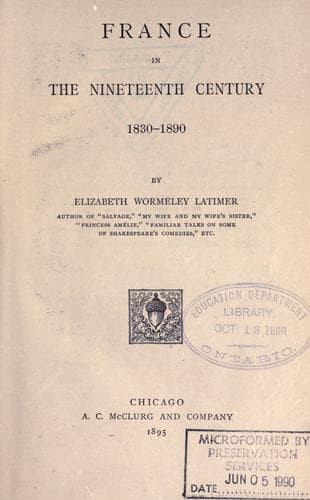
France in the Nineteenth CenturyLatimer, Elizabeth Wormeley
History
France in the Nineteenth Century
Latimer, Elizabeth Wormeley
France -- History -- 1789-1900
In 1833 Lamartine began his political career by entering the Chamber
of Deputies. Some one said of him that he formed a party by himself,--a
party of one. He pleaded for the abolition of capital punishment,
for the amelioration of the poorer classes, for the emancipation
of slaves in the colonies, and for various other social reforms;
but he was never known as a republican.
In 1847 he published his "Histoire des Girondins," which was received
by the public with deep interest and applause. It is not always
accurate in small particulars, but it is one of the most fascinating
books of history ever written, and has had the good fortune to be
singularly well translated. Alexandre Dumas is said to have told
its author: "You have elevated romance to the dignity of history."
When the revolution of February, 1848, broke out, Lamartine, being
unwell, did not make his way on the first day through the crowds
to the Chamber of Deputies, nor did he go thither on the second,
looking on the affair as an _émeute_ likely to be followed only
by a change of ministry. But when news was brought to him which
made him feel it was a very serious affair, he went at once to the
Chamber. On entering, he was seized upon by men of all parties,
but especially by republicans, who drew him into a side-room and
told him that the king had abdicated. He had always advocated the
regency of the Duchess of Orleans in the event of Louis Philippe's
death, in place of that of the Duc de Nemours. The men who addressed
him implored him, as the most popular man in France, to put himself
at the head of a movement to make the Duchess of Orleans regent
during her son's minority, adding that France under a woman and
a child would soon drift into a republic. Lamartine sat for some
minutes at a table with his face bowed on his hands. He was praying,
he says, for light. Then he arose, and after saying that he had
never been a republican, added that _now_ he was for a republic,
without any intermediate regency, either of the duchess or of Nemours.
With acclamations, the party went back into the Chamber to await
events.
We know already how the duchess was received, and how a mob broke
into the Chamber. A provisional government was demanded, in the
midst of indescribable tumult; and by the suffrages of a crowd of
roughs quite as much as by the action of the deputies, a provisional
government of five members (afterwards increased to seven) was
voted in, the names being written down with a pencil by Lamartine
on the spur of the moment. The five men thus nominated and chosen
to be rulers of France were Lamartine, Crémieux, Ledru-Rollin,
Garnier-Pagès, and Arago.
Meantime in the Hôtel-de-Ville the mob had set up another provisional
government under Socialistic leaders, and the first thing the more
genuine provisional government had to do was to get rid of the
others.
Public-domain text, read in full here on John Shaqi.
Reviews
Reviews
No reviews yet
Be the first to share your thoughts on this work.
Elsewhere in the archive
Join the Discussion
Join the discussion
Sign in to leave a comment or review.
Sign InorCreate an account