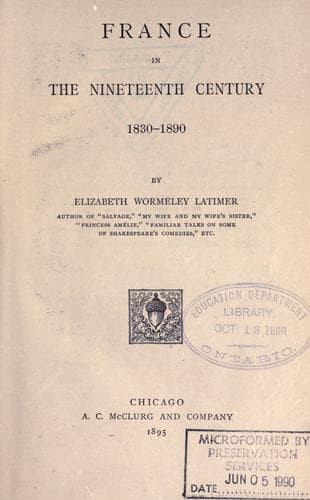
France in the Nineteenth CenturyLatimer, Elizabeth Wormeley
History
France in the Nineteenth Century
Latimer, Elizabeth Wormeley
France -- History -- 1789-1900
A month later, April 15, another outbreak was planned. The chief
club leaders wished it to be headed by Ledru-Rollin and Blanqui,--the
latter a conspirator in Louis Philippe's time. But Ledru-Rollin
refused to serve with Blanqui, having discovered from documents
in his office (that of Minister of Justice) that Blanqui had once
been a Government spy. "Well, then," said the club leaders, "since
you decline to be our chief, you shall to-morrow share the fate
of your colleagues." Ledru-Rollin, after a terrible night of
vacillation, resolved to throw himself on Lamartine's generosity.
He went to him at daybreak and told him of the impending danger.
At once Lamartine sent him to call out the National Guard, while
he himself summoned the Garde Mobile. The National Guard had been
reorganized; but there were no regular soldiers in Paris,--they had
been sent away to satisfy the people. The commander of the National
Guard, however, refused to let his men be called out on the occasion;
and Lamartine, on hearing this, went to the Hôtel-de-Ville alone. But
help came to him from an unexpected quarter. General Changarnier,
who had been appointed ambassador to Berlin, called at Lamartine's
house to return thanks for his appointment. Madame de Lamartine
told him of the danger that menaced her husband, and he repaired
at once to the Hôtel-de-Ville. There he found only about twelve
hundred boys of the Garde Mobile to oppose the expected two hundred
thousand insurgents. He drew his Garde Mobile into the building,
and prepared to stand a siege. There from early morning till the
next day Lamartine remained with Marrast, the Mayor of Paris. He
says that he harangued the mob from thirty to forty times. The other
members of the Government remained in one of the public offices. With
much difficulty the National Guard, whose organization was not yet
complete, was brought upon the scene. The procession of the insurgents
was cut in two, the commander of the National Guard employing the
same tactics as those which the Duke of Wellington had used a week
earlier, when dealing in London with the Chartist procession. The
result was the complete discomfiture of the insurgents.
A few days afterwards the members of the Provisional Government
sat twelve hours, on thrones erected for them under the Arch of
Triumph, to see Gardes Mobiles, National Guards, troops of the
line, and armed workmen, file past them, all shouting for Lamartine
and Order! It was probably the proudest moment of Lamartine's life;
in that flood-tide of his popularity he easily could have seized
supreme power.
All through the provinces disturbances went on. The object of the
Red Republicans had at first been to oppose the election of the
National Assembly. So long as France remained under the provisional
dictatorship of Lamartine and his colleagues, and the regular troops
were kept out of Paris, they hoped to be able to seize supreme
power, by a _coup de main_.
Public-domain text, read in full here on John Shaqi.
Reviews
Reviews
No reviews yet
Be the first to share your thoughts on this work.
Elsewhere in the archive
Join the Discussion
Join the discussion
Sign in to leave a comment or review.
Sign InorCreate an account