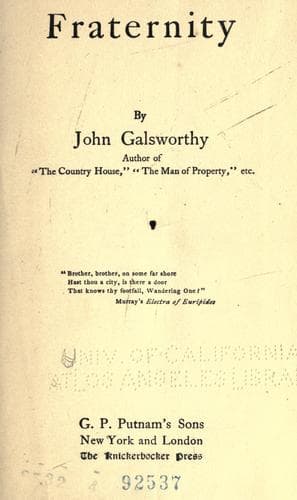
England -- Social life and customs -- 20th century -- Fiction; London (England) -- Fiction; Upper class families -- England -- Fiction
Now that the mornings were nice--she said with some animation--she got
up much earlier, and did her needlework first thing; she then “did out”
the room. There were mouse-holes in her room, and she had bought a trap.
She had caught a mouse last night. She hadn't liked to kill it; she had
put it in a tin box, and let it go when she went out. Quick to see that
Hilary was interested in this, as well he might be, she told him that
she could not bear to see cats hungry or lost dogs, especially lost
dogs, and she described to him one that she had seen. She had not liked
to tell a policeman; they stared so hard. Those words were of strange
omen, and Hilary turned his head away. The little model, perceiving that
she had made an effect of some sort, tried to deepen it. She had
heard they did all sorts of things to people--but, seeing at once from
Hilary's face that she was not improving her effect, she broke off
suddenly, and hastily began to tell him of her breakfast, of how
comfortable she was now she had got her clothes; how she liked her room;
how old Mr. Creed was very funny, never taking any notice of her when he
met her in the morning. Then followed a minute account of where she had
been trying to get work; of an engagement promised; Mr. Lennard, too,
still wanted her to pose to him. At this she gashed a look at Hilary,
then cast down her eyes. She could get plenty of work if she began that
way. But she hadn't, because he had told her not, and, of course, she
didn't want to; she liked coming to Mr. Stone so much. And she got on
very well, and she liked London, and she liked the shops. She mentioned
neither Hughs nor Mrs. Hughs. In all this rigmarole, told with such
obvious purpose, stolidity was strangely mingled with almost cunning
quickness to see the effect made; but the dog-like devotion was never
quite out of her eyes when they were fixed on Hilary.
This look got through the weakest places in what little armour Nature
had bestowed on him. It touched one of the least conceited and most
amiable of men profoundly. He felt it an honour that anything so young
as this should regard him in that way. He had always tried to keep
out of his mind that which might have given him the key to her special
feeling for himself--those words of the painter of still life: “She's
got a story of some sort.” But it flashed across him suddenly like an
inspiration: If her story were the simplest of all stories--the direct,
rather brutal, love affair of a village boy and girl--would not she,
naturally given to surrender, be forced this time to the very antithesis
of that young animal amour which had brought on her such, sharp
consequences?
Public-domain text, read in full here on John Shaqi.
Reviews
Reviews
No reviews yet
Be the first to share your thoughts on this work.
Elsewhere in the archive
Join the Discussion
Join the discussion
Sign in to leave a comment or review.
Sign InorCreate an account