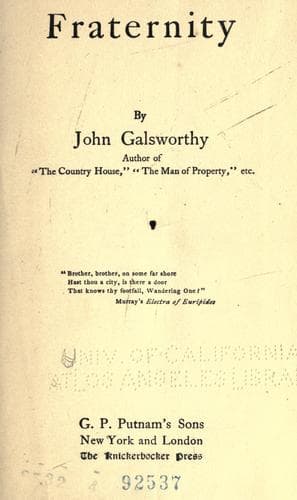
England -- Social life and customs -- 20th century -- Fiction; London (England) -- Fiction; Upper class families -- England -- Fiction
Thus, then, they reached the great consoler, the grey resolver of
all human tangles, haven of men and angels, the police court. It was
situated in a back street. Like trails of ooze, when the tide, neither
ebb nor flow, is leaving and making for some estuary, trails of
human beings were moving to and from it. The faces of these shuffling
“shadows” wore a look as though masked with some hard but threadbare
stuff-the look of those whom Life has squeezed into a last resort.
Within the porches lay a stagnant marsh of suppliants, through whose
centre trickled to and fro that stream of ooze. An old policeman, too,
like some grey lighthouse, marked the entrance to the port of refuge.
Close to that lighthouse the old butler edged his way. The love of
regularity, and of an established order of affairs, born in him and
fostered by a life passed in the service of the “Honorable Bateson” and
the other gentry, made him cling instinctively to the only person in
this crowd whom he could tell for certain to be on the side of law
and order. Something in his oblong face and lank, scanty hair parted
precisely in the middle, something in that high collar supporting his
lean gills, not subservient exactly, but as it were suggesting that he
was in league against all this low-class of fellow, made the policeman
say to him:
“What's your business, daddy?”
“Oh!” the old butler answered. “This poor woman. I'm a witness to her
battery.”
The policeman cast his not unkindly look over the figure of the
seamstress. “You stand here,” he said; “I'll pass you in directly.”
And soon by his offices the two were passed into the port of refuge.
They sat down side by side on the edge of a long, hard, wooden bench;
Creed fixing his eyes, whose colour had run into a brownish rim round
their centres, on the magistrate, as in old days sun-worshippers would
sit blinking devoutly at the sun; and Mrs. Hughs fixing her eyes on her
lap, while tears of agony trickled down her face. On her unwounded arm
the baby slept. In front of them, and unregarded, filed one by one
those shadows who had drunk the day before too deeply of the waters
of forgetfulness. To-day, instead, they were to drink the water of
remembrance, poured out for them with no uncertain hand. And somewhere
very far away, it may have been that Justice sat with her ironic smile
watching men judge their shadows. She had watched them so long about
that business. With her elementary idea that hares and tortoises should
not be made to start from the same mark she had a little given up
expecting to be asked to come and lend a hand; they had gone so far
beyond her. Perhaps she knew, too, that men no longer punished, but now
only reformed, their erring brothers, and this made her heart as light
as the hearts of those who had been in the prisons where they were no
longer punished.
Public-domain text, read in full here on John Shaqi.
Reviews
Reviews
No reviews yet
Be the first to share your thoughts on this work.
Elsewhere in the archive
Join the Discussion
Join the discussion
Sign in to leave a comment or review.
Sign InorCreate an account