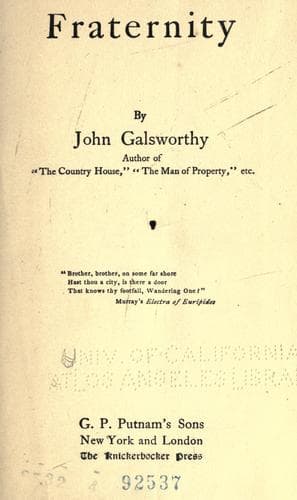
England -- Social life and customs -- 20th century -- Fiction; London (England) -- Fiction; Upper class families -- England -- Fiction
That same afternoon in High Street, Kensington, “Westminister,” with his
coat-collar raised against the inclement wind, his old hat spotted with
rain, was drawing at a clay pipe and fixing his iron-rimmed gaze on
those who passed him by. It had been a day when singularly few as yet
had bought from him his faintly green-tinged journal, and the low class
of fellow who sold the other evening prints had especially exasperated
him. His single mind, always torn to some extent between an ingrained
loyalty to his employers and those politics of his which differed from
his paper's, had vented itself twice since coming on his stand; once in
these words to the seller of “Pell Mells”: “I stupulated with you not to
come beyond the lamp-post. Don't you never speak to me again--a-crowdin'
of me off my stand”; and once to the younger vendors of the less
expensive journals, thus: “Oh, you boys! I'll make you regret of
it--a-snappin' up my customers under my very nose! Wait until ye're
old!” To which the boys had answered: “All right, daddy; don't you have
a fit. You'll be a deader soon enough without that, y'know!”
It was now his time for tea, but “Pell Mell” having gone to partake of
this refreshment, he waited on, hoping against hope to get a customer or
two of that low fellow's. And while in black insulation he stood there a
timid voice said at his elbow--
“Mr. Creed!”
The aged butler turned, and saw the little model.
“Oh,” he said dryly, “it's you, is it?” His mind, with its incessant
love of rank, knowing that she earned her living as a handmaid to that
disorderly establishment, the House of Art, had from the first classed
her as lower than a lady's-maid. Recent events had made him think of
her unkindly. Her new clothes, which he had not been privileged to see
before, while giving him a sense of Sunday, deepened his moral doubts.
“And where are you living now?” he said in tones incorporating these
feelings.
“I'm not to tell you.”
“Oh, very well. Keep yourself to yourself.”
The little model's lower lip drooped more than ever. There were dark
marks beneath her eyes; her face was altogether rather pinched and
pitiful.
“Won't you tell me any news?” she said in her matter-of-fact voice.
The old butler gave a strange grunt.
“Ho!” he said. “The baby's dead, and buried to-morrer.”
“Dead!” repeated the little model.
“I'm a-goin' to the funeral--Brompton Cemetery. Half-past nine I leave
the door. And that's a-beginnin' at the end. The man's in prison, and
the woman's gone a shadder of herself.”
The little model rubbed her hands against her skirt.
“What did he go to prison for?”
“For assaultin' of her; I was witness to his battery.”
“Why did he assault her?”
Creed looked at her, and, wagging his head, answered:
“That's best known to them as caused of it.”
The little model's face went the colour of carnations.
Public-domain text, read in full here on John Shaqi.
Reviews
Reviews
No reviews yet
Be the first to share your thoughts on this work.
Elsewhere in the archive
Join the Discussion
Join the discussion
Sign in to leave a comment or review.
Sign InorCreate an account