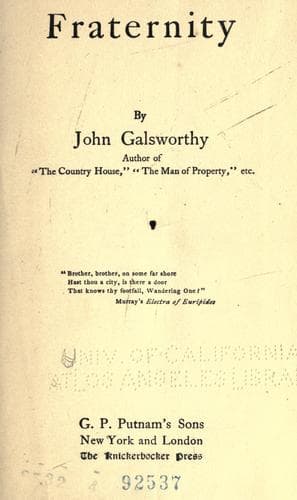
England -- Social life and customs -- 20th century -- Fiction; London (England) -- Fiction; Upper class families -- England -- Fiction
Following out the instinct planted so deeply in human nature for
treating with the utmost care and at great expense when dead those, who,
when alive, have been served with careless parsimony, there started
from the door of No. 1 in Hound Street a funeral procession of three
four-wheeled cabs. The first bore the little coffin, on which lay a
great white wreath (gift of Cecilia and Thyme). The second bore Mrs.
Hughs, her son Stanley, and Joshua Creed. The third bore Martin Stone.
In the first cab Silence was presiding with the scent of lilies over him
who in his short life had made so little noise, the small grey shadow
which had crept so quietly into being, and, taking his chance when he
was not noticed, had crept so quietly out again. Never had he felt so
restful, so much at home, as in that little common coffin, washed as he
was to an unnatural whiteness, and wrapped in his mother's only spare
sheet. Away from all the strife of men he was Journeying to a greater
peace. His little aloe-plant had flowered; and, between the open windows
of the only carriage he had ever been inside, the wind--which, who
knows? he had perhaps become--stirred the fronds of fern and the flowers
of his funeral wreath. Thus he was going from that world where all men
were his brothers.
From the second cab the same wind was rigidly excluded, and there was
silence, broken by the aged butler's breathing. Dressed in his Newmarket
coat, he was recalling with a certain sense of luxury past, journeys
in four-wheeled cabs--occasions when, seated beside a box corded and
secured with sealing-wax, he had taken his master's plate for safety to
the bank; occasions when, under a roof piled up with guns and boxes, he
had sat holding the “Honorable Bateson's” dog; occasions when, with
some young person by his side, he had driven at the tail of a baptismal,
nuptial, or funeral cortege. These memories of past grandeur came back
to him with curious poignancy, and for some reason the words kept rising
in his mind: 'For richer or poorer, for better or worser, in health
and in sick places, till death do us part.' But in the midst of the
exaltation of these recollections the old heart beneath his old red
flannel chest-protector--that companion of his exile--twittering faintly
at short intervals, made him look at the woman by his side. He longed to
convey to her some little of the satisfaction he felt in the fact that
this was by no means the low class of funeral it might have been. He
doubted whether, with her woman's mind, she was getting all the comfort
she could out of three four-wheeled cabs and a wreath of lilies. The
seamstress's thin face, with its pinched, passive look, was indeed
thinner, quieter, than ever. What she was thinking of he could not tell.
There were so many things she might be thinking of. She, too, no doubt,
had seen her grandeur, if but in the solitary drive away from the church
where, eight years ago, she and Hughs had listened to the words
now haunting Creed.
Public-domain text, read in full here on John Shaqi.
Reviews
Reviews
No reviews yet
Be the first to share your thoughts on this work.
Elsewhere in the archive
Join the Discussion
Join the discussion
Sign in to leave a comment or review.
Sign InorCreate an account