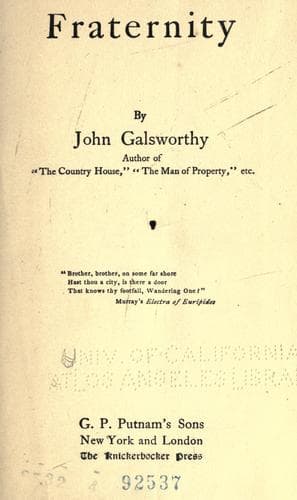
England -- Social life and customs -- 20th century -- Fiction; London (England) -- Fiction; Upper class families -- England -- Fiction
The new wine, if it does not break the old bottle, after fierce
effervescence seethes and bubbles quietly.
It was so in Mr. Stone's old bottle, hour by hour and day by day,
throughout the month. A pinker, robuster look came back to his cheeks;
his blue eyes, fixed on distance, had in them more light; his knees
regained their powers; he bathed, and, all unknown to him, for he only
saw the waters he cleaved with his ineffably slow stroke, Hilary and
Martin, on alternate weeks, and keeping at a proper distance, for fear
he should see them doing him a service, attended at that function in
case Mr. Stone should again remain too long seated at the bottom of the
Serpentine. Each morning after his cocoa and porridge he could be heard
sweeping out his room with extraordinary vigour, and as ten o'clock came
near anyone who listened would remark a sound of air escaping, as he
moved up and down on his toes in preparation for the labours of the
day. No letters, of course, nor any newspapers disturbed the supreme and
perfect self-containment of this life devoted to Fraternity--no letters,
partly because he lacked a known address, partly because for years he
had not answered them; and with regard to newspapers, once a month he
went to a Public Library, and could be seen with the last four numbers
of two weekly reviews before him, making himself acquainted with the
habits of those days, and moving his lips as though in prayer. At ten
each morning anyone in the corridor outside his room was startled by the
whirr of an alarum clock; perfect silence followed; then rose a sound of
shuffling, whistling, rustling, broken by sharply muttered words; soon
from this turbid lake of sound the articulate, thin fluting of an old
man's voice streamed forth. This, alternating with the squeak of a quill
pen, went on till the alarum clock once more went off. Then he who stood
outside could smell that Mr. Stone would shortly eat; if, stimulated
by that scent, he entered; he might see the author of the “Book of
Universal Brotherhood” with a baked potato in one hand and a cup of
hot milk in the other; on the table, too, the ruined forms of eggs,
tomatoes, oranges, bananas, figs, prunes, cheese, and honeycomb, which
had passed into other forms already, together with a loaf of wholemeal
bread. Mr. Stone would presently emerge in his cottage-woven tweeds,
and old hat of green-black felt; or, if wet, in a long coat of yellow
gaberdine, and sou'wester cap of the same material; but always with a
little osier fruit-bag in his hand. Thus equipped, he walked down to
Rose and Thorn's, entered, and to the first man he saw handed the osier
fruit-bag, some coins, and a little book containing seven leaves, headed
“Food: Monday, Tuesday, Wednesday,” and so forth. He then stood looking
through the pickles in some jar or other at things beyond, with one
hand held out, fingers upwards, awaiting the return of his little osier
fruit-bag. Feeling presently that it had been restored to him, he
Public-domain text, read in full here on John Shaqi.
Reviews
Reviews
No reviews yet
Be the first to share your thoughts on this work.
Elsewhere in the archive
Join the Discussion
Join the discussion
Sign in to leave a comment or review.
Sign InorCreate an account