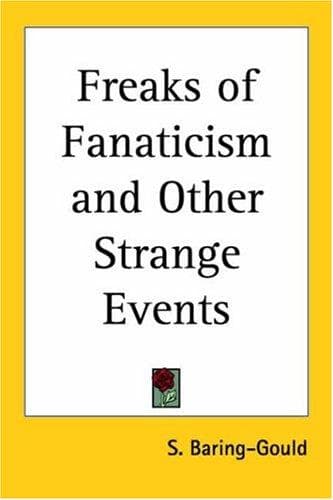
Freaks of Fanaticism, and Other Strange EventsBaring-Gould, S. (Sabine)
Religion
Freaks of Fanaticism, and Other Strange Events
Baring-Gould, S. (Sabine)
History; Mysticism; Patarines
The town council now sent deputies to the Protestant princes, Dukes
Ernest and Francis of Lüneburg, the Landgrave Philip of Hesse, and
Count Philip of Waldeck, brother of the prince-bishop, to promise
the adhesion of the city to the Smalkald union, and to request
their assistance against their bishop. The situation was singular.
The city sought assistance of the Protestant union against their
prince, desiring to overthrow his power, under the plea that he
was a Catholic bishop. And the bishop, at heart a Lutheran, and
utterly indifferent to his religious position and responsibilities,
was determined to coerce his subjects into obedience, that he
might retain his rank and revenue as prince, intending, when the
city returned to its obedience, to shake off his episcopal office,
to Lutheranize his subjects, and remain their sovereign prince,
and possibly transform the ecclesiastical into a hereditary
principality, the appanage of a family of which he would be the
founder. He had already provided himself with a concubine, Anna
Pölmann, by whom he had children.
Whilst the senate was engaged in treating with the Protestant
princes, negotiations continued with the bishop, at the diets
convoked successively at Dulmen and Wollbeck, but they were as
fruitless as before. The deputies separated on the 9th December,
agreeing to meet again on the 21st of the same month.
At this time there arrived in Münster a formal refutation of
the theses of Rottmann, by John of Deventer, provincial of the
Franciscans at Cologne.[81] The magistrates had repeatedly
complained that "the refusal of the Catholics to reply to Bernard
Rottmann was the sole cause of all the evil." At the same time they
had forbidden the Catholic clergy to preach or to make use of the
press in Münster. This answer came like a surprise upon them. It was
carried by the foes of the clergy to the magistrates. The news of
the appearance of this counterblast created the wildest excitement.
"The citizens, assembled in great crowds, ran about the streets to
hear what was being said. Some announced that the victory would
remain with Rottmann, others declared that he would never recover
the blow."
[81] Kerssenbroeck, p. 332.
The provosts of the guilds hastily drew up a petition to the senate
to expel the clergy from the town, and to confiscate their goods;
but the magistrates refused to comply with this requisition, which
would have at once stirred up civil war.[82]
[82] _Ibid._ pp. 335-7.
Public-domain text, read in full here on John Shaqi.
Reviews
Reviews
No reviews yet
Be the first to share your thoughts on this work.
Elsewhere in the archive
Join the Discussion
Join the discussion
Sign in to leave a comment or review.
Sign InorCreate an account