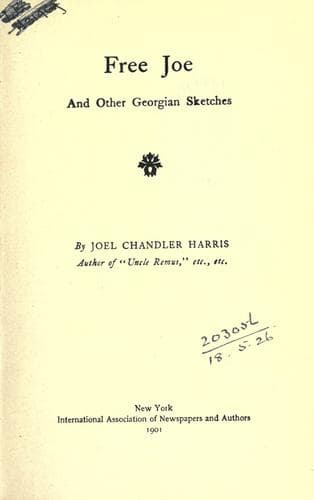
Free Joe and Other Georgian SketchesHarris, Joel Chandler
General
Free Joe and Other Georgian Sketches
Harris, Joel Chandler
Georgia -- Social life and customs -- Fiction
When Azalia heard that the Northern ladies had been called on by the
mistress of Waverly, that portion of its inhabitants which was in the
habit of keeping up the forms of sociability made haste to follow her
example, so that Helen and her aunt were made to feel at home in spite
of themselves. General Garwood was a frequent caller, ostensibly to
engage in sectional controversies with Miss Tewksbury, which he seemed
to enjoy keenly; but Mrs. Haley observed that when Helen was not visible
the general rarely prolonged his discussions with her aunt.
The Rev. Arthur Hill also called with some degree of regularity; and it
was finally understood that Helen would, at least temporarily, take the
place of Miss Lou Hornsby as organist of the little Episcopal church in
the Tacky settlement, as soon as Mr. Goolsby, the fat and enterprising
book-agent, had led the fair Louisa to the altar. This wedding occurred
in due time, and was quite an event in Azalia's social history. Goolsby
was stout, but gallant; and Miss Hornsby made a tolerably handsome
bride, notwithstanding a tendency to giggle when her deportment should
have been dignified. Helen furnished the music, General Garwood gave the
bride away, and the little preacher read the ceremony quite
impressively; so that with the flowers and other favors, and the
subsequent dinner--which Mrs. Haley called an "infair"--the occasion was
a very happy and successful one.
Among those who were present, not as invited guests, but by virtue of
their unimportance, were Mrs. Stucky and her son Bud. They were
followed and flanked by quite a number of their neighbors, who gazed on
the festal scene with an impressive curiosity that can not be described.
Pale-faced, wide-eyed, statuesque, their presence, interpreted by a
vivid imagination, might have been regarded as an omen of impending
misfortune. They stood on the outskirts of the wedding company, gazing
on the scene apparently without an emotion of sympathy or interest. They
were there, it seemed, to see what new caper the townspeople had
concluded to cut, to regard it solemnly, and to regret it with grave
faces when the lights were out and the fantastic procession had drifted
away to the village.
Public-domain text, read in full here on John Shaqi.
Reviews
Reviews
No reviews yet
Be the first to share your thoughts on this work.
Elsewhere in the archive
Join the Discussion
Join the discussion
Sign in to leave a comment or review.
Sign InorCreate an account