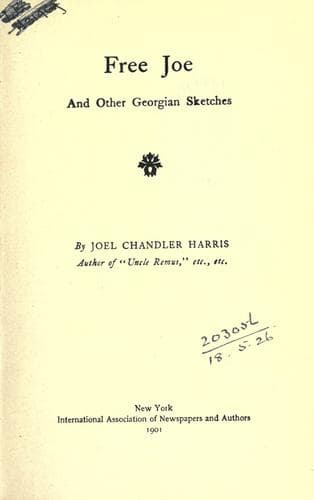
Free Joe and Other Georgian SketchesHarris, Joel Chandler
General
Free Joe and Other Georgian Sketches
Harris, Joel Chandler
Georgia -- Social life and customs -- Fiction
"Well, now, honey," remarked Mrs. Haley, "if he ast you to walk wi' 'im,
he had his reasons. I've got my own idee," she added with a chuckle. "I
know one thing--I know he's monstrous fond of some of the Northron
folks. Ain't you never hearn, how, endurin' of the war, they fotch home
a Yankee soldier along wi' Hallie's husband, an' buried 'em side by
side? They tell me that Hallie's husband an' the Yankee was mighty nigh
the same age, an' had a sorter favor. If that's so," said Mrs. Haley,
with emphasis, "then two mighty likely chaps was knocked over on account
of the everlastin' nigger."
All this was very interesting to Helen and her aunt, and they were
anxious to learn all the particulars in regard to the young Federal
soldier who had found burial at Waverly.
"What his name was," said Mrs. Haley, "I'll never tell you. Old Prince,
the carriage-driver, can tell you lots more'n I can. He foun' 'em on the
groun', an' he fotch 'em home. Prince use to be a mighty good nigger
before freedom come out, but now he ain't much better'n the balance of
'em. You all 'ill see him when you go over thar, bekaze he's in an' out
of the house constant. He'll tell you all about it if you're mighty
perlite. Folks is got so they has to be mighty perlite to niggers sence
the war. Yit I'll not deny that it's easy to be perlite to old Uncle
Prince, bekaze he's mighty perlite hisself. He's what I call a high-bred
nigger." Mrs. Haley said this with an air of pride, as if she were in
some measure responsible for Uncle Prince's good breeding.
V
IT came to pass that Helen Eustis and her aunt lost the sense of
loneliness which they had found so oppressive during the first weeks of
their visit. In the people about them they found a never-failing fund of
entertainment. They found in the climate, too, a source of health and
strength. The resinous odor of the pines was always in their nostrils;
the far, faint undertones of music the winds made in the trees were
always in their ears. The provinciality of the people, which some of the
political correspondents describe as distressing, was so genuinely
American in all its forms and manifestations that these Boston women
were enabled to draw from it, now and then, a whiff of New England air.
They recognized characteristics that made them feel thoroughly at home.
Perhaps, so far as Helen was concerned, there were other reasons that
reconciled her to her surroundings. At any rate, she was reconciled.
More than this, she was happy. Her eyes sparkled, and the roses of
health bloomed on her cheeks. All her movements were tributes to the
buoyancy and energy of her nature. The little rector found out what this
energy amounted to, when, on one occasion, he proposed to accompany her
on one of her walks. It was a five-mile excursion; and he returned, as
Mrs. Haley expressed it, "a used-up man."
Public-domain text, read in full here on John Shaqi.
Reviews
Reviews
No reviews yet
Be the first to share your thoughts on this work.
Elsewhere in the archive
Join the Discussion
Join the discussion
Sign in to leave a comment or review.
Sign InorCreate an account