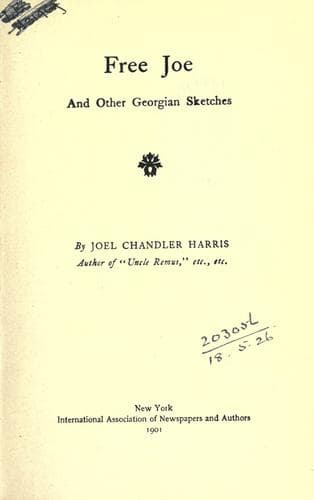
Free Joe and Other Georgian SketchesHarris, Joel Chandler
General
Free Joe and Other Georgian Sketches
Harris, Joel Chandler
Georgia -- Social life and customs -- Fiction
The old man stood near the tall mantel, facing the group. There was
nothing servile in his attitude: on the contrary, his manner, when
addressing the gentleman who had once been his master, suggested easy,
not to say affectionate, familiarity. The firelight, shining on his
face, revealed a countenance at once rugged and friendly. It was a face
in which humor had many a tough struggle with dignity. In looks and
tone, in word and gesture, there was unmistakable evidence of that
peculiar form of urbanity that can not be dissociated from gentility.
These things were more apparent, perhaps, to Helen and her aunt than to
those who, from long association, had become accustomed to Uncle
Prince's peculiarities.
"Dem times ain't never got clean out'n my min'," said the old negro,
"but it bin so long sence I runn'd over um, dat I dunner wharbouts ter
begin skacely."
"You can tell it all in your own way," said General Garwood.
"Yasser, dat's so, but I fear'd it's a mighty po' way. Bless yo' soul,
honey," Uncle Prince went on, "dey was rough times, en it look like ter
me dat ef dey wuz ter come 'roun' ag'in hit 'u'd take a mighty rank
runner fer ter ketch one nigger man w'at I'm got some 'quaintance wid.
Dey wuz rough times, but dey wa'n't rough 'long at fust. Shoo! no! dey
wuz dat slick dat dey ease we-all right down 'mongs' de wuss kind er
tribbylation, en we ain't none un us know it twel we er done dar.
"I know dis," the old man continued, addressing himself exclusively to
Miss Eustis and her aunt; "I knows dat we-all wuz a-gittin' 'long
mighty well, w'en one day Marse Peyton dar, he tuck 'n' jinded wid de
army; en den 'twa'n't long 'fo' word come dat my young marster w'at
gwine ter college in Ferginny, done gone en jinded wid um. I ax myse'f,
I say, w'at de name er goodness does dey want wid boy like dat? Hit's de
Lord's trufe, ma'am, dat ar chile wa'n't mo' dan gwine on sixteen, ef he
wuz dat, en I up'n' ax myse'f, I did, w'at does de war want wid baby
like dat? Min' you, ma'am, I ain't fin' out den w'at war wuz--I ain't
know w'at a great big maw she got."
"My son Ethel," said Mrs. Garwood, the soft tone of her voice chiming
with the notes of the piano, "was attending the University of Virginia
at Charlottesville. He was just sixteen."
"Yassum," said Uncle Prince, rubbing his hands together gently, and
gazing into the glowing embers, as if searching there for some clue that
would aid him in recalling the past. "Yassum, my young marster wuz des
gone by sixteen year, kaze 'twa'n't so mighty long 'fo' dat, dat we-all
sont 'im a great big box er fixin's en doin's fer ter git dar on he's
birfday; en I sot up mighty nigh twel day tryin' ter make some 'lasses
candy fer ter put in dar wid de yuther doin's."
Here Uncle Prince smiled broadly at the fire.
Public-domain text, read in full here on John Shaqi.
Reviews
Reviews
No reviews yet
Be the first to share your thoughts on this work.
Elsewhere in the archive
Join the Discussion
Join the discussion
Sign in to leave a comment or review.
Sign InorCreate an account