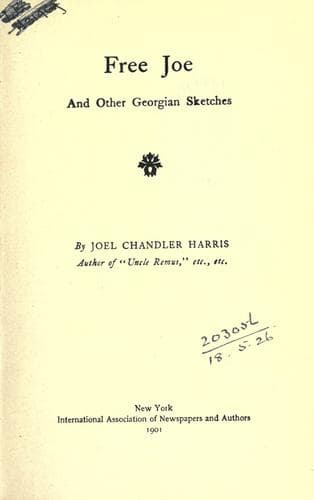
Free Joe and Other Georgian SketchesHarris, Joel Chandler
General
Free Joe and Other Georgian Sketches
Harris, Joel Chandler
Georgia -- Social life and customs -- Fiction
Looking closely at Hightower, Chichester could see that his face was
colorless. His eyes were sunken, but shone with a peculiar brilliancy,
and great beads of perspiration stood on his forehead. His whole
appearance was that of a man distraught. Here was another tragedy!
Seeking a momentary escape from the confusion and perplexity into which
he had been plunged by the horrible events of the night, Chichester
passed out into the yard, and stood bareheaded in the cool wind that was
faintly stirring among the trees. The stars shone remote and tranquil,
and the serenity of the mountain, the awful silence that seemed to be,
not the absence of sound, but the presence of some spiritual entity,
gave assurance of peace. Out there, in the cold air, or in the wide
skies, or in the vast gulf of night, there was nothing to suggest
either pity or compassion--only the mysterious tranquillity of nature.
This was the end, so far as Chichester knew. He never entered the
Hightower house again. Something prompted him to saddle his horse and
ride down the mountain. The tragedy and its attendant troubles were
never reported in the newspapers. The peace of the mountain remained
undisturbed, its silence unbroken.
But should Chichester, who at last accounts was surveying a line of
railway in Mexico, ever return to Lost Mountain, he would find Tuck
Peevy a gaunt and shrunken creature, working on the Hightower farm, and
managing such of its small affairs as call for management. Sometimes,
when the day's work is over, and Peevy sits at the fireside saying
nothing, Abe Hightower will raise a paralytic hand, and cry out as loud
as he can that it's almost time for Babe to quit playing 'possum. At
such times we may be sure that, so far as Peevy is concerned, there is
still trouble on Lost Mountain.
AZALIA
I
MISS HELEN OSBORNE EUSTIS of Boston was very much astonished one day in
the early fall of 1873 to receive a professional visit from Dr. Ephraim
Buxton, who for many years had been her father's family physician. The
astonishment was mutual; for Dr. Buxton had expected to find Miss Eustis
in bed, or at least in the attitude of a patient, whereas she was seated
in an easy chair, before a glowing grate--which the peculiarities of the
Boston climate sometimes render necessary, even in the early fall--and
appeared to be about as comfortable as a human being could well be.
Perhaps the appearance of comfort was heightened by the general air of
subdued luxury that pervaded the apartment into which Dr. Buxton had
been ushered. The draperies, the arrangement of the little affairs that
answer to the name of bric-a-brac, the adjustment of the
furniture--everything--conveyed the impression of peace and repose; and
the chief element of this perfect harmony was Miss Eustis herself, who
rose to greet the doctor as he entered. She regarded the physician with
eyes that somehow seemed to be wise and kind, and with a smile that was
at once sincere and humorous.
Public-domain text, read in full here on John Shaqi.
Reviews
Reviews
No reviews yet
Be the first to share your thoughts on this work.
Elsewhere in the archive
Join the Discussion
Join the discussion
Sign in to leave a comment or review.
Sign InorCreate an account