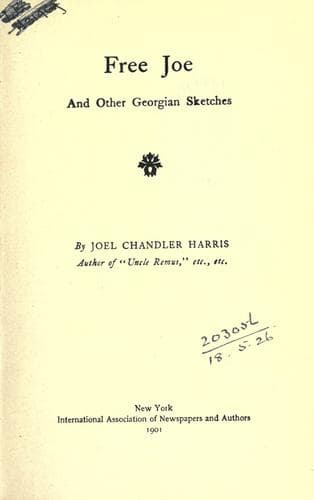
Free Joe and Other Georgian SketchesHarris, Joel Chandler
General
Free Joe and Other Georgian Sketches
Harris, Joel Chandler
Georgia -- Social life and customs -- Fiction
It is not to be supposed, however, that Miss Eustis was simply droll.
She was unconventional at all times, and sometimes wilful--inheriting
that native strength of mind and mother wit which are generally admitted
to be a part of the equipment of the typical American woman. If she was
not the ideal young woman, at least she possessed some of the attractive
qualities that one tries--sometimes unsuccessfully--to discover in one's
dearest friends. From her infancy, until near the close of the war, she
had had the advantage of her father's companionship, so that her ideas
were womanly rather than merely feminine. She had never been permitted
to regard the world from the dormer-windows of a young ladies' seminary,
in consequence of which her views of life in general, and of mankind in
particular, were orderly and rational. Such indulgence as her father had
given her had served to strengthen her individuality rather than to
confirm her temper; and, though she had a strong and stubborn will of
her own, her tact was such that her wilfulness appeared to be the most
natural as well as the most charming thing in the world. Moreover, she
possessed in a remarkable degree that buoyancy of mind that is more
engaging than mere geniality.
Her father was no less a person than Charles Osborne Eustis, the noted
philanthropist and abolitionist, whose death in 1867 was the occasion of
quite a controversy in New England--a controversy based on the fact that
he had opposed some of the most virulent schemes of his coworkers at a
time when abolitionism had not yet gathered its full strength. Mr.
Eustis, in his day, was in the habit of boasting that his daughter had a
great deal of genuine American spirit--the spirit that one set of
circumstances drives to provinciality, another to patriotism, and
another to originality.
Helen had spent two long winters in Europe without parting with the fine
flavor of her originality. She was exceedingly modest in her designs,
too, for she went neither as a missionary nor as a repentant. She found
no foreign social shrines that she thought worthy of worshiping at. She
admired what was genuine, and tolerated such shams as obtruded
themselves on her attention. Her father's connections had enabled her to
see something of the real home-life of England; and she was delighted,
but not greatly surprised, to find that at its best it was not greatly
different from the home life to which she had been accustomed.
Public-domain text, read in full here on John Shaqi.
Reviews
Reviews
No reviews yet
Be the first to share your thoughts on this work.
Elsewhere in the archive
Join the Discussion
Join the discussion
Sign in to leave a comment or review.
Sign InorCreate an account