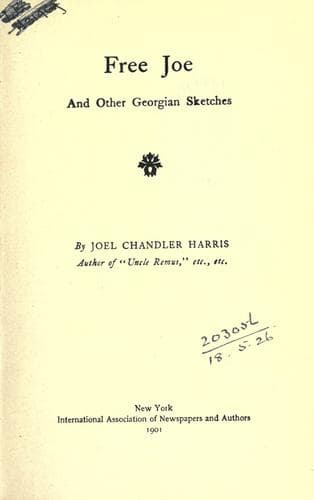
Free Joe and Other Georgian SketchesHarris, Joel Chandler
General
Free Joe and Other Georgian Sketches
Harris, Joel Chandler
Georgia -- Social life and customs -- Fiction
General Garwood made himself exceedingly agreeable. He pointed out the
interesting places along the road, gave the ladies little bits of local
history that were at least entertaining. In Atlanta, where there was a
delay of a few hours, he drove them over the battle-fields, and by his
graphic descriptions gave them a new idea of the heat and fury of war.
In short, he made himself so agreeable in every way that Miss Tewksbury
felt at liberty to challenge his opinions on various subjects. They had
numberless little controversies about the rights and wrongs of the war,
and the perplexing problems that grew out of its results. So far as Miss
Tewksbury was concerned, she found General Garwood's large tolerance
somewhat irritating, for it left her no excuse for the employment of her
most effective arguments.
"Did you surrender your prejudices at Appomattox?" Miss Tewksbury asked
him on one occasion.
"Oh, by no means; you remember we were allowed to retain our side-arms
and our saddle-horses," he replied, laughing. "I still have my
prejudices, but I trust they are more important than those I entertained
in my youth. Certainly they are less uncomfortable."
"Well," said Miss Tewksbury, "you are still unrepentant, and that is
more serious than any number of prejudices."
"There is nothing to repent of," said the general, smiling, a little
sadly as Helen thought. "It has all passed away utterly. The best we
can do is that which seems right and just and necessary. My duty was as
plain to me in 1861, when I was a boy of twenty, as it is to-day. It
seemed to be my duty then to serve my State and section; my duty now
seems to be to help good people everywhere to restore the Union, and to
heal the wounds of the war."
"I'm _very_ glad to hear you say so," exclaimed Miss Tewksbury in a tone
that made Helen shiver. "I was afraid it was quite otherwise. It seems
to me, that, if I lived here, I should either hate the people who
conquered me, or else the sin of slavery would weigh heavily on my
conscience."
"I can appreciate that feeling, I think," said General Garwood, "but the
American conscience is a very healthy one--not likely to succumb to
influences that are mainly malarial in their nature; and even from your
point of view some good can be found in American slavery."
"I have never found it," said Miss Tewksbury.
"You must admit that but for slavery the negroes who are here would be
savages in Africa. As it is, they have had the benefit of more than two
hundred years' contact with the white race. If they are at all fitted
for citizenship, the result is due to the civilizing influence of
slavery. It seems to me that they are vastly better off as American
citizens, even though they have endured the discipline of slavery, than
they would be as savages in Africa."
Miss Tewksbury's eyes snapped. "Did this make slavery right?" she asked.
Public-domain text, read in full here on John Shaqi.
Reviews
Reviews
No reviews yet
Be the first to share your thoughts on this work.
Elsewhere in the archive
Join the Discussion
Join the discussion
Sign in to leave a comment or review.
Sign InorCreate an account