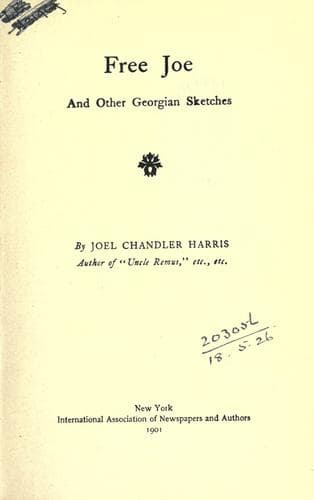
Free Joe and Other Georgian SketchesHarris, Joel Chandler
General
Free Joe and Other Georgian Sketches
Harris, Joel Chandler
Georgia -- Social life and customs -- Fiction
Away back in the forties, or perhaps even earlier, when there was some
excitement in all parts of the country in regard to railroad building,
one of Georgia's most famous orators had alluded in the legislature to
Azalia as "the natural gateway of the commerce of the Empire State of
the South." This fine phrase stuck in the memories of the people of
Azalia and their posterity; and the passing traveler, since that day and
time, has heard a good deal of it. There is no doubt that the figure was
fairly applicable before the railways were built; for, as has been
explained, Azalia was the meeting-place of the wagon-trains from all
parts of the State in going to market. When the cotton-laden wagons met
at Azalia, they parted company no more until they had reached August.
The natural result of this was that Azalia, in one way and another, saw
a good deal of life--much that was entertaining, and a good deal that
was exciting. Another result was that the people had considerable
practise in the art of hospitality; for it frequently happened that the
comfortable tavern, which Azalia's commercial importance had made
necessary at a very early period of the town's history, was full to
overflowing with planters accompanying their wagons, and lawyers
traveling from court to court. At such times the worthy townspeople
would come to the rescue, and offer the shelter of their homes to the
belated wayfarer.
There was another feature of Azalia worthy of attention. It was in a
measure the site and centre of a mission--the headquarters, so to speak,
of a very earnest and patient effort to infuse energy and ambition into
that indescribable class of people known in that region as the
piny-woods "Tackies." Within a stone's throw of Azalia there was a
scattering settlement of these Tackies. They had settled there before
the Revolution, and had remained there ever since, unchanged and
unchangeable, steeped in poverty of the most desolate description, and
living the narrowest lives possible in this great Republic. They had
attracted the attention of the Rev. Arthur Hill, an Episcopalian
minister, who conceived an idea that the squalid settlement near Azalia
afforded a fine field for missionary labor. Mr. Hill established himself
in Azalia, built and furnished a little church in the settlement, and
entered on a career of the most earnest and persevering charity. To all
appearances his labor was thrown away; but he was possessed by both
faith and hope, and never allowed himself to be disheartened. All his
time, as well as the modest fortune left him by his wife who was dead,
was devoted to the work of improving and elevating the Tackies; and he
never permitted himself to doubt for an instant that reasonable success
was crowning his efforts. He was gentle, patient, and somewhat finical.
Public-domain text, read in full here on John Shaqi.
Reviews
Reviews
No reviews yet
Be the first to share your thoughts on this work.
Elsewhere in the archive
Join the Discussion
Join the discussion
Sign in to leave a comment or review.
Sign InorCreate an account