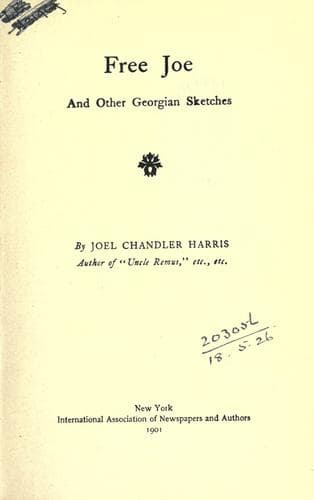
Free Joe and Other Georgian SketchesHarris, Joel Chandler
General
Free Joe and Other Georgian Sketches
Harris, Joel Chandler
Georgia -- Social life and customs -- Fiction
One morning, an old-fashioned carriage, drawn by a pair of heavy-limbed
horses, lumbered up to the tavern door. Helen watched it with some
degree of expectancy. The curtains and upholstering were faded and worn,
and the panels were dingy with age. The negro driver was old and
obsequious. He jumped from his high seat, opened the door, let down a
flight of steps, and then stood with his hat off, the November sun
glistening on his bald head. Two ladies alighted. One was old, and one
was young, but both were arrayed in deep mourning. The old lady had an
abundance of gray hair that was combed straight back from her forehead,
and her features, gave evidence of great decision of character. The
young lady had large, lustrous eyes, and the pallor of her face was in
strange contrast with her sombre drapery. These were the ladies from
Waverly, as the Garwood place was called; and Helen and her aunt met
them a few moments later.
"I am so pleased to meet you," said the old lady, with a smile that made
her face beautiful. "And this is Miss Tewksbury. Really, I have heard my
son speak of you so often that I seem to know you. This is my daughter
Hallie. She doesn't go out often, but she insisted on coming with me
to-day."
"I'm very glad you came," said Helen, sitting by the pale young woman
after the greetings were over.
"I think you are lovely," said Hallie, with the tone of one who is
settling a question that had previously been debated. Her clear eyes
from which innocence, unconquered and undimmed by trouble, shone forth,
fastened themselves on Helen's face. The admiration they expressed was
unqualified and unadulterated. It was the admiration of a child. But
the eyes were not those of a child: they were such as Helen had seen in
old paintings, and the pathos that seemed part of their beauty belonged
definitely to the past.
"I lovely?" exclaimed Helen in astonishment, blushing a little. "I have
never been accused of such a thing before."
"You have such a beautiful complexion," Hallie went on placidly, her
eyes still fixed on Helen's face. "I had heard--some one had told
me--that you were an invalid. I was so sorry." The beautiful eyes
drooped, and Hallie sighed gently.
"My invalidism is a myth," Helen replied, somewhat puzzled to account
for the impression the pale young woman made on her. "It is the
invention of my aunt and our family physician. They have a theory that
my lungs are affected, and that the air of the pine-woods will do me
good."
"Oh, I hope and trust it will," exclaimed Hallie, with an earnestness
that Helen could trace to no reasonable basis but affectation. "Oh, I
do hope it will! You are so young--so full of life."
"My dear child," said Helen, with mock gravity, "I am older than you
are--ever so much older."
The lustrous eyes closed, and for a moment the long silken lashes rested
against the pale cheek. Then the eyes opened, and gazed at Helen
appealingly.
"Oh, impossible! How could that be? I was sixteen in 1862."
Public-domain text, read in full here on John Shaqi.
Reviews
Reviews
No reviews yet
Be the first to share your thoughts on this work.
Elsewhere in the archive
Join the Discussion
Join the discussion
Sign in to leave a comment or review.
Sign InorCreate an account