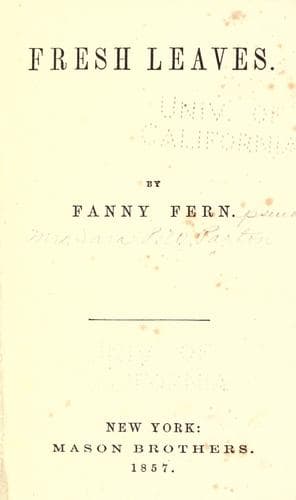
American essays -- 19th century; Short stories, American
“Come, now, Jo,” said his friend, taking out his penknife, and sitting
down on a stump to whittle. “You are always a railing at the
aristocracy, as you call ’em. I never knew a man who talks as you do,
who was not an aristocrat at heart, worshiping the very wealth and
station he sneered at. Don’t be a fool, John. We are far happier, or
might be, with our teams, plenty of jobs, and good health, than these
aristocrats, as you call them, who half the time are tossing on their
pillows, because this ship hasn’t arrived in port, or that land
speculation has burst up, or stocks depreciated, or some such cursed
canker at the root of all their gourds. Now there’s poor Jacob Ford; of
what use are all his riches, now his daughter’s heart is broke? And
Percy Lee, too--will his fine education and book learning get him out of
the clutches of the law? Have a little charity, Jo. It hurts a man worse
to fall from such a height into a prison, than it would you or me, from
a dray-cart. Gad--I pity him; his worst enemy couldn’t pile up the agony
any higher.”
“Pity him!” said Jo, mockingly--“a swindling rascal like that--to
break a pretty girl’s heart!”
“Jo,” said his friend, shutting up his penknife, and looking him
steadily in the eye, “have you always said no to the tempting devil in
_your_ heart? Did you never charge a stranger more than the law allows
for a job? Did no poor girl ever curse the hour she saw the light, for
your sake?”
“Well, Mr. Parson, what if all that were true?” asked Jo, with an
abortive attempt at a laugh. “I can’t see what it has to do with what we
are talking about; hang it.”
“Just this,” answered his friend. “He who is without sin, only, is to
cast the first stone.”
“O, get out,” said Jo, cracking his whip over his horse’s head, and
taking refuge, like many other cornered disputants, in flight.
* * * * *
And Percy Lee! From the hour in which he passed from the heaven of
Mary’s smile, up to the present moment, in which he paced like a caged
lion up and down his narrow bounds, what untold agonies were his! Why
had he wrecked happiness, love, honor, all in one fatal moment? Why had
he prostituted his God-given talents so madly to sin? Let those answer
who have in like manner sinned, and who have expiated that sin, by a
life-long brand upon the brow and a life-long misery in the heart. “Let
him who thinketh he standeth, take heed lest he fall.”
CHAPTER IV.
“I can’t remember,” said Mary, two months after Percy’s arrest, “I can’t
remember,” raising herself, and laying her emaciated hand upon her brow.
“Have I been sick, mamma?”
“Yes, Mary,” replied her mother, repressing her tears of joy at the
sound of her child’s voice.
“Where’s Percy, mamma?”
But before Lucy could answer, she again relapsed into stupor. Another
hour passed--there was reason in her glance. “Mamma? Percy--take me to
him”--said Mary, with a burst of tears, as she strove vainly to rise
from her couch.
Public-domain text, read in full here on John Shaqi.
Reviews
Reviews
No reviews yet
Be the first to share your thoughts on this work.
Elsewhere in the archive
Join the Discussion
Join the discussion
Sign in to leave a comment or review.
Sign InorCreate an account