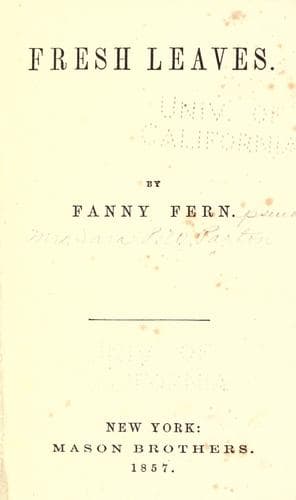
American essays -- 19th century; Short stories, American
That the furnaces failed to keep the prisoners from freezing in
winter, or that there was no proper ventilation in summer, was,
therefore, nobody’s meddling business. Better that _they_ should suffer,
year in and year out, than that a flaw should be publicly picked in any
scheme set afoot by the “modern Howard.” The officers elected to preside
over Bluff Hill prison, were as stony as its walls, and showed curious
visitors round the work-shops, amid its rows of pallid faces, pointing
out here a disgraced clergyman, there a ruined lawyer, yonder a wrecked
merchant, with as much nonchalance as a brutal keeper would stir up the
caged beasts in a menagerie, for the amusement of the crowd; with as
little thought that these fallen beings were _men_ and brothers, as if
the Omniscient eye noted no dark stain of sin, hidden from human sight,
on _their_ souls.
They gave you leave to stop as long as you pleased, and watch the
muscles of your victim’s face, work with emotion under your gaze. You
could take your own time to speculate upon the scowl of defiance, or the
set teeth of hate, as you flaunted leisurely past their prison uniform,
in your silk and broadcloth; or you could stand under the fair blue sky,
in the prison-yard, when the roll beat for dinner, and see them in
file, by twos--guarded--march with locked step and folded arms, to their
eating-room. The beardless boy branded in your remembering eye for life,
wherever you might hereafter meet him, for this his first crime, how
hard soever against fearful odds, he might struggle upward to virtue and
heaven. You might follow the sad procession to thair meals, where the
fat, comfortably-fed chaplain craved a blessing over food, from which
the very dog at his door would have turned hungry away; or you could go
into the prison hospital, and view the accommodation (?) for the
sick--the cots so narrow that a man could not turn in them; or you could
investigate “The Douche,” which the keeper would tell you, with a bland
smile, “conquered even old prison birds;” or you could peep into the
cells (philanthropically furnished by this “modern Howard” with a
Bible), so dark that at the brightest noonday no prisoner could read a
syllable; or you could see the row of coffins standing on an end in the
hall, kept on hand “for sudden emergencies;” or any other horrors of the
place, for which your morbid curiosity was appetized.
Public-domain text, read in full here on John Shaqi.
Reviews
Reviews
No reviews yet
Be the first to share your thoughts on this work.
Elsewhere in the archive
Join the Discussion
Join the discussion
Sign in to leave a comment or review.
Sign InorCreate an account