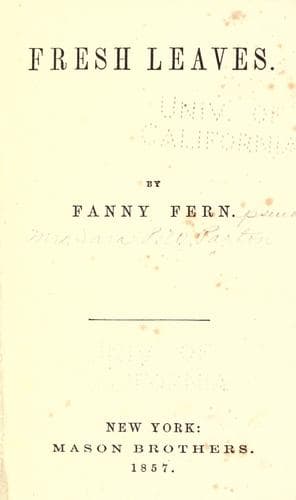
American essays -- 19th century; Short stories, American
“Lucy,” said Jacob--and the poor old man’s limbs shook beneath
him--“this must be the last arrow in the quiver. Nothing can come after
this. Let her be, Lucy,”--and he withdrew his wife’s hands, as she
bathed Mary’s temples--“let her be: ’tain’t no use to rouse her up to
her misery--to kill her by inches this way. I am ready to lie down side
of her. Lucy--I couldn’t muster heart to tell you, till a worse blow
came, that we are beggars. ’Tain’t no matter now.”
“God be merciful!” said Lucy, overwhelmed with this swift accumulation
of trouble.
“Yes, you may well say that. Just enough left to keep us from starving.
My heart has been with _her_, you see,” said Jacob, looking at Mary,
“and my head hasn’t been clear about things, as it used to be, and so it
has come to this. I wouldn’t mind it, if she only--” and Jacob dropped
his head hopelessly upon his breast. Then raising it again, and wiping
his eyes, as he looked at Mary, he said: “She never will look more like
an angel than she does now. I thought she’d live to close these old
eyes, and that my grand-children would play about my knee, but you see
how it has gone, Lucy.”
* * * * *
The red flag of the auctioneer, so often the signal of distress,
floated before Jacob Ford’s door. Strange feet roved over the old house;
strange eyes profaned the household gods. Careless fingers tested the
quality of Mary’s harp and guitar; and voices which in sunnier days had
echoed through those halls in blandest tones, now fell upon the ear,
poisonous with cold malice. When once the pursuit is started, and the
game scented, every hound joins in the cry; each fierce paw must have
its clutch at the quivering heart, each greedy tongue lap up the ebbing
life-blood. Never was beauty’s crown worn more winningly, more
unobtrusively, less triumphantly, than by Mary Ford; but to those whom
nature had less favored, it was the sin never to be forgiven; and so
fair lips _hoped_ the stories were not true about her, while they
reiterated them at every street corner; and bosom friends, when inquired
of as to their truth, rolled up their eyes, sighed like a pair of
bellows, and with a deprecating wave of the hand, replied, in melancholy
tones, “don’t ask _me_,” thus throwing the responsibility upon the
listener to construe it into little or much; pantomimic looks and
gestures not yet having been pronounced indictable by the statute book;
others simply nodded their heads, in a mysterious manner, as if they had
it at their charitable option to send the whole family to perdition,
with a monosyllable.
CHAPTER VII.
Public-domain text, read in full here on John Shaqi.
Reviews
Reviews
No reviews yet
Be the first to share your thoughts on this work.
Elsewhere in the archive
Join the Discussion
Join the discussion
Sign in to leave a comment or review.
Sign InorCreate an account