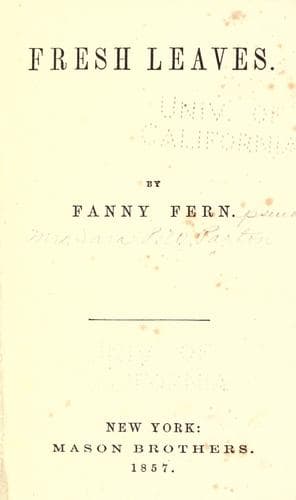
American essays -- 19th century; Short stories, American
It was Sabbath morning. Jacob stood at his cottage door, gazing out.
Each tiny blade of grass bent quivering under its glistening dew-drop.
The little ground-birds on the gravel walk were picking up their early
breakfast; the robins were singing overhead. The little swallows flew
twittering round the cottage eaves. The leaves were rustling with their
mysterious music. The silver mist wreathed playfully over the
hill-sides, whose summits lay bathed in sunshine. Every thing seemed
full of joyous life. Where was the Master hand which regulated all that
harmony? The birds sang--the leaves danced--the brooks sparkled--the bee
hummed--why did He make _man_ only to suffer? It was all a riddle to
poor Jacob. He took his staff, and sauntered away under the drooping
lindens. The Sabbath bell was calling the simple villagers to church.
Across the meadows, down the grassy lane--the rosy maiden, the bent old
man, and the lisping little child. Jacob looked after them as they went.
Jacob never had been to church--not since he was a little child. Sunday
he always posted his books, squared up his accounts, wrote business
letters and the like of that; shortening the day at both ends by getting
up later and going to bed earlier. Sunday to him was no different from
any other day in the week--except that he transferred his business from
his counting-room to his parlor; and yet--here he was, leaning on his
staff, before the village church, almost wishing to go in with its
humble people. He looked about as if he expected somebody to be
astonished that Jacob Ford should be standing so near a church door; but
nobody seemed to notice it, or look at all surprised. By-and-by he crept
on a little further, and seated himself on a stone bench in the porch,
with his chin upon his staff. The butterfly and the bee passed in and
out; even the little birds flew in at the church door, and out at the
open window; and still old Jacob sat there--he could scarcely have told
why. Now he hears the choir sing,
“Jesus, I my cross have taken,
All to leave, and follow Thee;
Naked--poor--despised--forsaken--
Thou from hence my all shalt be.
“Though the world despise and leave me,
They have left my Saviour too;
Human hearts and hopes deceive me,
Thou art not like them, untrue.”
As the song died away, old Jacob’s tears flowed down his cheeks; the
words soothed his troubled spirit like a mother’s lullaby.
“Come unto me all ye that labor and are heavy laden, and I will give
you rest.”
Who promised that?
How did the minister know how “heavy laden” was Jacob’s spirit?
How did _he_ know that for sixty years he had been drawing water from
broken cisterns? Chasing shadows even to the grave’s brink?
How did _he_ know that on that balmy Sabbath morning, his heart was
aching for _something_ to lean on that would not pass away?
“Come unto me.”
Public-domain text, read in full here on John Shaqi.
Reviews
Reviews
No reviews yet
Be the first to share your thoughts on this work.
Elsewhere in the archive
Join the Discussion
Join the discussion
Sign in to leave a comment or review.
Sign InorCreate an account