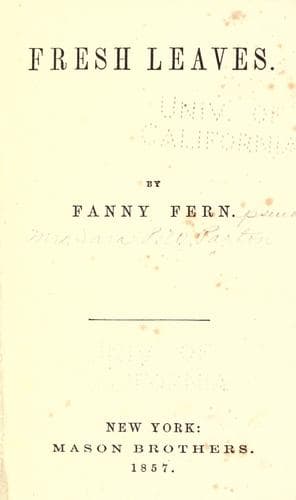
American essays -- 19th century; Short stories, American
Mr. Parish walked home in a very thoughtful mood. Through his
acquaintances in the city, he had learned the history of the family. He
knew the length and breadth of the shadow which had fallen across their
hearth-stone. He saw that it was true, as Lucy had said, that her own
strength was fast failing; still it seemed to him sacrilege to bestow
Mary’s hand in marriage, when her heart was so benumbed and dead. He
would have offered her a shelter in his own house, had he been master of
it; but, unfortunately, he had married a lady who lost no opportunity to
remind him that her dowry of twenty thousand dollars was payment in full
for the total abnegation of his free will. This was not the first
occasion on which the clanking of this gentleman’s golden fetters had
sounded unmusically in his reverend ears; in truth, he would much have
preferred his liberty, even at the expense of eking out a small salary
by farming, as did the neighboring country clergy. Mrs. Parish lost no
opportunity to remind her husband that he was sold, by such pleasant
remarks as the following: That it was time _her_ house was re-painted,
or _her_ barn re-roofed, or _her_ carry-all re-cushioned. When she felt
_unusually_ hymeneal, she would say, “Mr. Parish, you can use _my_
horses to-day, if you will drive carefully.” That she invariably and
sweetly deferred to her husband’s opinion in company, was no proof of
the absence of a private conjugal understanding, that he was to consider
himself merely her echo.
Little did his brother clergymen who exchanged with him in their
thread-bare suits of black, dream of the price at which his pleasant
parsonage surroundings were purchased. Little did they dream, when they
innocently brought along their wives and babies on such occasions, the
suffering it entailed on “brother Parish.”
No, poor simple souls, they went home charmed with the hospitality of
their host and hostess, charmed with their conjugal happiness, and
marveling as they returned to their own houses, what made their rooms
seem so much smaller, and their fare so much more frugal than before.
Had they been clairvoyantly endowed, they might have seen brother
Parish, after he had smilingly bowed them down the nicely rolled gravel
walk to their wagons, return meekly to the parlor, to be reminded for
the hundredth time, by Mrs. Parish, of that twenty thousand dollar
obligation. Well might personal feelings come in, to strengthen his
ministerial scruples, lest he should join carelessly in wedlock, hands
which death only could unclasp.
* * * * *
Public-domain text, read in full here on John Shaqi.
Reviews
Reviews
No reviews yet
Be the first to share your thoughts on this work.
Elsewhere in the archive
Join the Discussion
Join the discussion
Sign in to leave a comment or review.
Sign InorCreate an account