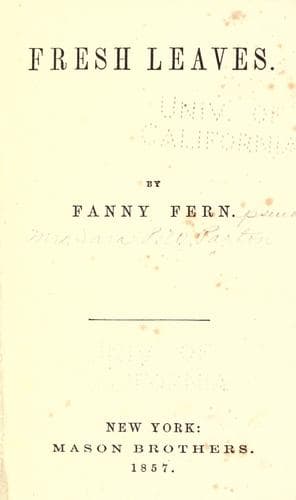
American essays -- 19th century; Short stories, American
“Yes,” said Lucy, “_even now_. We all err, sir. He was only
nineteen--young to marry; but Mary’s heart was bound up in him. He
didn’t mean it, sir--I don’t know how it was. God help us all.
“Well, we buried Jacob; then we had none to look to--Mary and I. We
were poor. I was feeble. Then Mary’s lover came--the rich Mr. Shaw. You
are ill, sir?”
“No--no,” replied the peddler; “go on--your story interests me.”
“Well, he wanted to marry Mary, although he saw how it was. It was all
one to her, you know, sir. She was crazed like--though so sweet and
gentle. I did it for the best, sir,” said Lucy, mournfully. “I thought
when I died Mary would have a home.”
“Go on,” said the peddler. “He treated her kindly?” he asked, with a
dark frown.
“For a little,” answered Lucy. “He wearied after a while. I might have
known it--I was to blame, sir--her heart was broken. When the babe
opened its eyes, she closed her’s, and I _alone_ mourned for her.”
“O, God!” groaned the peddler.
“It moves you, sir,” said Lucy; “perhaps you, too, have known
trouble.”
The peddler bowed his head without replying.
“Then, sir, he brought a gay young thing into the house--his
mistress--not his wife. He never looked upon his child; he cursed
me and it. I gave it our name; I called it Fanny Ford; and we
crept away, the babe and I, up in the attic;--then all was
confusion--extravagance--ruin;--then he died, sir--and since--you see us
here--you know now, sir, why I, leaning over the grave’s brink, yet
shrink back and cling to life for _her_ sake,” and she looked at Fanny.
“Would you trust her with me?” asked the peddler, with his eyes bent
upon the ground. “I am all alone in the world--I have none to love--none
who love me--I am poor, but while I have a crust, she shall never want.”
“It is a great charge,” replied Lucy. “If you should weary, sir?”
“Then may God forget me,” said the peddler, earnestly, kneeling at
Lucy’s feet.
Lucy bent on him a gaze searching as truth, but she read nothing in
that upturned face to give the lie to those solemn words. Pointing to
Fanny, she said,
“Before God--and as you hope for peace at the last?”
The peddler bowed his head upon Lucy’s withered hand, and faltered
out, “I promise.”
CHAPTER XVII.
“Good morning, Zekiel,” said John Pray. “Glad to see you--you must
tell the old lady to go ahead and finish this pile of vests in a
twinkling; business is brisk now. Why, what’s this?” said he. “These
vests unfinished? How’s that? Don’t the pay suit? What’s the trouble
now?”
“Don’t,” said Zekiel--“don’t--stop a bit--I’m as tough as any man--but
there’s some things I can’t stand;” and he dashed a tear away.
“What’s the matter now?” asked John. “Is the old lady dissatisfied
with her pay?”
“Don’t--I say,” said Zekiel;--“hold up--don’t harrow a man that
way--she’s dead--I tell you stone dead. She never’ll make no more vests
for nobody. I never shall forget what I saw there this morning, never.
Public-domain text, read in full here on John Shaqi.
Reviews
Reviews
No reviews yet
Be the first to share your thoughts on this work.
Elsewhere in the archive
Join the Discussion
Join the discussion
Sign in to leave a comment or review.
Sign InorCreate an account