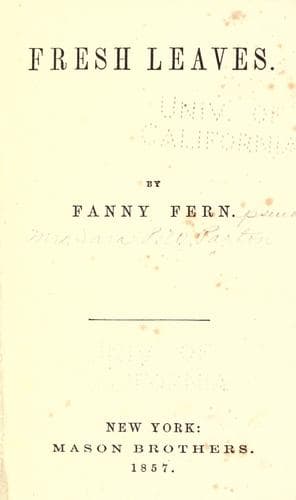
American essays -- 19th century; Short stories, American
The wagon was brought, and its living freight stowed carefully away in
the remote corners. The oil-cloth covering was buttoned carefully down
on all sides, as it had been during the winter; Mrs. Quip said it was
hot, but maybe it would crack the oil-cloth to roll it up for the breeze
to play through. Susan, Mary, and Fanny, therefore, took a vapor bath,
on the back seat. Mrs. Quip, seated at John’s side, excluded, with her
big black bonnet, any stray breeze which might have found entrance that
way, to the refreshing of the gasping passengers. Dobbin moved on; he
had been up that hot, dusty hill, many a Sunday before, and understood
perfectly well how to keep his strength in reserve for the usual
accession to his load on the village green, in the shape of the
Falstaffian Aunt Hepsibah, Miss Butts, the milliner, and Deacon Tufts,
who were duly piled in on the gasping occupants behind. Mrs. Quip being
also on the alert to fill up any stray chinks in the “waggin” with “them
children who stopped to rest in the road, when they oughter go straight
to meetin’.”
The unlading of Mrs. Quip’s wagon at the meeting-house door, was an
exhibition much “reckoned on” by the graceless young men of the village,
who always collected on the steps for the purpose, and with mock
gallantry assisted Mrs. Quip in clambering over the wheels, suppressing
their mirth at her stereotyped exhortation, as she glanced at Dobbin,
“to see that they didn’t start the critter.”
It was a work of time to draw out the unctuous Aunt Hepsibah; Deacon
Tufts, more wiry and agile, “helped hisself,” as Mrs. Quip remarked. The
crowning delight was the evacuation of the wagon, by Miss Butts--who,
with a mincing glance at the men, circumspectly extended one finger of
her right hand--gingerly exposed the tip of the toe of her slipper, and
with sundry little shrieks and exclamations, prolonged indefinitely the
delicious agony of her descent, as the young gentlemen by turns
profanely touched her virgin elbows. Thirty-nine years of single
blessedness had fully prepared her to appreciate these little masculine
attentions, of which she always made an exact memorandum in her
note-book (affixing the date) on reaching her seat in church. The
unappropriated Miss Butts wore rose-buds in her bonnet, as emblematical
of love’s young spring-time, and dressed in shepherdess style; nature,
perhaps, suggesting the idea, by placing the _crook_ in her back.
Public-domain text, read in full here on John Shaqi.
Reviews
Reviews
No reviews yet
Be the first to share your thoughts on this work.
Elsewhere in the archive
Join the Discussion
Join the discussion
Sign in to leave a comment or review.
Sign InorCreate an account