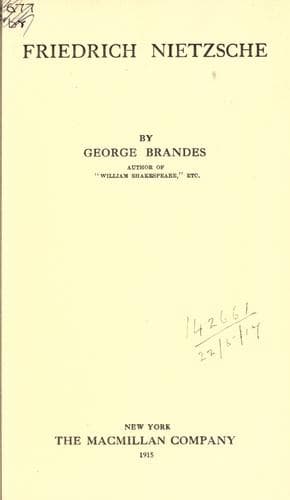
Nietzsche, Friedrich Wilhelm, 1844-1900; Philosophers -- Germany -- Biography; Philosophy, German -- 19th century
To be able to explain Nietzsche's rapid and overwhelming triumph, one
would want the key to the secret of the psychological life of our time.
He bewitched the age, though he seems opposed to all its instincts.
The age is ultra-democratic; he won its favour as an aristocrat. The
age is borne on a rising wave of religious reaction; he conquered with
his pronounced irreligion. The age is struggling with social questions
of the most difficult and far-reaching kind; he, the thinker of the
age, left all these questions on one side as of secondary importance.
He was an enemy of the humanitarianism of the present day and of its
doctrine of happiness; he had a passion for proving how much that is
base and mean may conceal itself beneath the guise of pity, love of
one's neighbour and unselfishness; he assailed pessimism and scorned
optimism; he attacked the ethics of the philosophers with the same
violence as the thinkers of the eighteenth century had attacked the
dogmas of the theologians. As he became an atheist from religion, so
did he become an immoralist from morality. Nevertheless the Voltairians
of the age could not claim him, since he was a mystic; and contemporary
anarchists had to reject him as an enthusiast for rulers and castes.
For all that, he must in some hidden way have been in accord with much
that is fermenting in our time, otherwise it would not have adopted
him as it has done. The fact of having known Nietzsche, or having been
in any way connected with him, is enough at present to make an author
famous--more famous, sometimes, than all his writings have made him.
What Nietzsche, as a young man admired more than anything else in
Schopenhauer and Richard Wagner was "the indomitable energy with which
they maintained their self-reliance in the midst of the hue and
cry raised against them by the whole cultured world." He made this
self-reliance his own, and this was no doubt the first thing to make an
impression.
In the next place the artist in him won over those to whom the
aphorisms of the thinker were obscure. With all his mental acuteness
he was a pronounced lyricist. In the autumn of 1888 he wrote of Heine:
"How he handled German! One day it will be said that Heine and I were
without comparison the supreme artists of the German language." One who
is not a German is but an imperfect judge of Nietzsche's treatment of
language; but in our day all German connoisseurs are agreed in calling
him the greatest stylist of German prose.
Public-domain text, read in full here on John Shaqi.
Reviews
Reviews
No reviews yet
Be the first to share your thoughts on this work.
Elsewhere in the archive
Join the Discussion
Join the discussion
Sign in to leave a comment or review.
Sign InorCreate an account