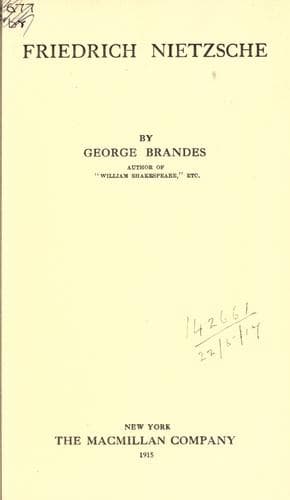
Nietzsche, Friedrich Wilhelm, 1844-1900; Philosophers -- Germany -- Biography; Philosophy, German -- 19th century
He further impressed his contemporaries by his psychological
profundity and abstruseness. His spiritual life has its abysses and
labyrinths. Self-contemplation provides him with immense material for
investigation. And he is not content with self-contemplation. His
craving for knowledge is a passion; covetousness he calls it: "In this
soul there dwells no unselfishness; on the contrary, an all-desiring
self that would see by the help of many as with its own eyes and grasp
as with its _own_ hands; this soul of mine would even choose to bring
back all the past and not lose anything that might belong to it. What a
flame is this covetousness of mine!"
The equally strong development of his lyrical and critical qualities
made a fascinating combination. But it was the cause of those reversals
of his personal relations which deprive his career (in much the same
way as Sören Kierkegaard's) of some of the dignity it might have
possessed. When a great personality crossed his path he called all his
lyricism to arms and with clash of sword on shield hailed the person in
question as a demigod or a god (Schopenhauer and Richard Wagner). When
later on he discovered the limitations of his hero, his enthusiasm was
apt to turn to hatred, and this hatred found vent without the smallest
regard to his former worship. This characteristic is offensively
conspicuous in Nietzsche's behaviour to Wagner. But who knows whether
this very lack of dignity has not contributed to increase the number
of Nietzsche's admirers in an age that is somewhat undignified on this
point!
In the last period of his life Nietzsche appeared rather as a prophet
than as a thinker. He predicts the Superman. And he makes no attempt
at logical proof, but proceeds from a reliance on the correctness
and sureness of his instinct, convinced that he himself represents a
life-promoting principle and his opponents one hostile to life.
To him the object of existence is, everywhere the production of genius.
The higher man in our day is like a vessel in which the future of the
race is fermenting in an impenetrable way, and more than one of these
vessels is burst or broken in the process. But the human race is not
ruined by the failure of a single creature. Man, as we know him, is
only a bridge, a transition from the animal to the superman. What
the ape is in relation to man, a laughingstock or a thing of shame,
that will man be to the superman. Hitherto every species has produced
something superior to itself. Nietzsche teaches that man too will and
must do the same. He has drawn a conclusion from Darwinism which Darwin
himself did not see.
In the last decade of the nineteenth century Nietzsche and Tolstoy
appeared as the two opposite poles. Nietzsche's morality is
aristocratic as Tolstoy's is popular, individualistic as Tolstoy's
is evangelical; it asserts the self-majesty of the individual, where
Tolstoy's proclaims the necessity of self-sacrifice.
Public-domain text, read in full here on John Shaqi.
Reviews
Reviews
No reviews yet
Be the first to share your thoughts on this work.
Elsewhere in the archive
Join the Discussion
Join the discussion
Sign in to leave a comment or review.
Sign InorCreate an account