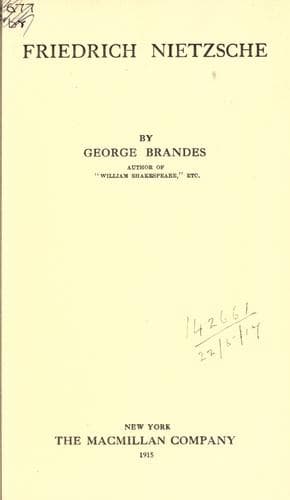
Nietzsche, Friedrich Wilhelm, 1844-1900; Philosophers -- Germany -- Biography; Philosophy, German -- 19th century
He begins by giving us plain, matter-of-fact information about
himself, speaking warmly and proudly of his father. The latter had
been tutor to four princesses of Altenburg before he was appointed to
his living. Out of respect-for Friedrich Wilhelm IV. he gave his son
the Hohenzollern names of Friedrich Wilhelm, and he felt the events of
1848 very keenly. His father only reached the age of thirty-six, and
Nietzsche lost him when he was himself five years old. But he ascribes
to paternal heredity his ability to feel at home in a world of high
and delicate things (_in einer Welt hoher und zarter Dinge_). For
all that, Nietzsche does not forget to bring in, here as elsewhere,
the supposition of his descent from Polish noblemen; but he did not
know this for a fact, and it was only established by Scharlitt's
investigation of the family seal.
He describes himself as what we should call a winning personality. He
has "never understood the art of arousing ill-feeling against himself."
He can tame every bear; he even makes clowns behave decently. However
out of tune the instrument "man" may be, he can coax a pleasing tone
out of it. During his years of teaching, even the laziest became
diligent under him. Whatever offence has been done him, has not been
the result of ill-will. The pitiful have wounded him more deeply than
the malicious.
Nor has he given vent to feelings of revenge or rancour. His conflict
with Christianity is only one instance among many of his antagonism to
resentful feelings. It is an altogether different matter that his very
nature is that of a warrior. But he confers distinction on the objects
of his attacks, and he has never waged war on private individuals, only
on types; thus in Strauss he saw nothing but the Culture-Philistine.
He attributes to himself an extremely vivid and sensitive instinct
of cleanliness. At the first contact the filth lying at the base of
another's nature is revealed to him. The unclean are therefore ill at
ease in his presence; nor does the sense of being seen through make
them any more fragrant.
And with true psychology he adds that his greatest danger--he means to
his spiritual health and balance--is loathing of mankind.
The loathing of mankind is doubtless the best modern expression for
what the ancients called misanthropy. No one knows what it is till
he has experienced it. When we read, for instance, in our youth of
Frederick the Great that in his later years he was possessed and
fettered by contempt for men, this appears to us an unfortunate
peculiarity which the king ought to have overcome; for of course he
must have seen other men about him besides those who flattered him for
the sake of advantage. But the loathing of mankind is a force that
surprises and overwhelms one, fed by hundreds of springs concealed
in subconsciousness. One only detects its presence after having long
entertained it unawares.
Public-domain text, read in full here on John Shaqi.
Reviews
Reviews
No reviews yet
Be the first to share your thoughts on this work.
Elsewhere in the archive
Join the Discussion
Join the discussion
Sign in to leave a comment or review.
Sign InorCreate an account