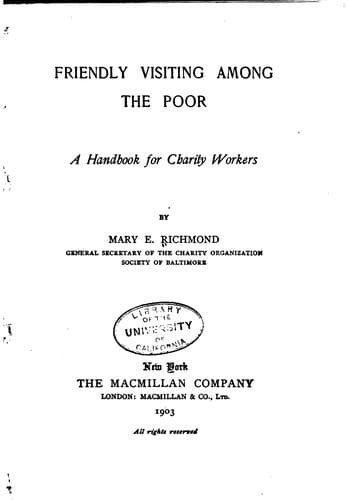
Friendly Visiting among the Poor: A Handbook for Charity WorkersRichmond, Mary Ellen
General
Friendly Visiting among the Poor: A Handbook for Charity Workers
Richmond, Mary Ellen
Friendly visiting
Two classes of invalids remain to be mentioned in this condensed
summary. First, accident cases, in which the visitor must be careful
to see that legal redress is obtained when the case is one for damages,
and must, at the same time, protect the victim from lawyers who are
glad to take a sure case for "half the proceeds." Second, incurables,
for whom homes are provided requiring an entrance fee, or for whom,
more often, nothing remains but the almshouse. The visitor can
sometimes secure the cooperation of friends and charities interested,
and so raise enough money to provide the fee for such an invalid, when,
without cooperation, as much money and more would be spent and the
patient remain in the end unprovided for. Charitable people often
{105} get tired; they will do a great deal for a while, and will then
get interested elsewhere, and grudge the help that is still needed. In
view of this failing, it is much better, in making plans for
incurables, to secure a lump sum that will make adequate provision,
than to depend upon the continued interest of a number of people.
The migration of invalids is the last point upon which I shall attempt
to touch under this head. Any one who has visited California, Florida,
Colorado, or any other part of our country where climatic conditions
are supposed to be favorable for invalids, will realize the
irresponsible way in which charitable people are accustomed to send the
sick where they do not belong. The worst of it is that the sudden
change of climate and the impossibility of securing proper care, so far
from effecting a cure, in many cases hasten death. "The saddest thing
about the life of a Denver minister," writes Rev. Samuel A. Eliot, "is
the number of lonely funerals that he is called upon to attend. Often
I have been hastily summoned to say a prayer over some poor body at the
undertaker's {106} shop, where there would be present just the
undertaker and the minister, with perhaps the keeper of the
boarding-house where the lad died or an officer of the Charity
Organization Society. I look at the youthful victim of ignorant
good-will borne to his neglected grave, I imagine the mother and
sisters in the farmhouse on the New England hillside, whose tenderness
might have soothed his last hours, and I think with bitterness of the
well-meant but misdirected charity which condemned him to a miserable
exile and a forlorn death." [2]
It must be remembered that change of climate is helpful only in the
earlier stages of disease, and only then when the patient is able to
live in comparative comfort, free from worry and anxiety. To send
invalids to a strange place in the name of charity, without providing
them with the means of subsistence, is the refinement of cruelty.
Public-domain text, read in full here on John Shaqi.
Reviews
Reviews
No reviews yet
Be the first to share your thoughts on this work.
Join the Discussion
Join the discussion
Sign in to leave a comment or review.
Sign InorCreate an account