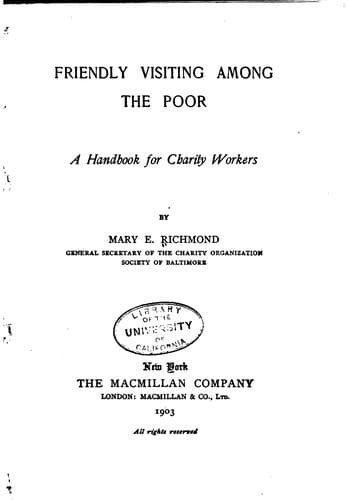
Friendly Visiting among the Poor: A Handbook for Charity WorkersRichmond, Mary Ellen
General
Friendly Visiting among the Poor: A Handbook for Charity Workers
Richmond, Mary Ellen
Friendly visiting
Collateral Readings: Publications of local Board of Health.
Proceedings of International Congress of Charities, Chicago, 1893,
volume on "Hospitals, Dispensaries, {107} and Nursing." "Instructive
District Nursing," M. K. Sedgewick in "Forum," Vol. XXII, pp. 297 _sq_.
"The Feeble-minded," Dr. George H. Knight in Proceedings of
Twenty-second National Conference of Charities, pp. 150 _sq_. See also
discussion in same volume, pp. 460 _sq_. "The Care of Epileptics,"
William P. Letchworth in Proceedings of Twenty-third National
Conference of Charities, pp. 199 _sq_. "Industrial Education of
Epileptics," Dr. William P. Spratling in Proceedings of Twenty-fourth
National Conference of Charities, pp. 69 _sq_. "Destitute
Convalescents: After Care of the Insane," Dr. Richard Dewey in the
same, pp. 76 _sq_. See also discussion on pp. 464 _sq_.
[1] "American Charities," p. 40.
[2] Proceedings of the Nineteenth Conference of Charities, Denver,
1892, pp. 91 _sq_.
{108}
CHAPTER VII
SPENDING AND SAVING
There is a new school of philanthropists that are inclined to make
light of thrift, and to class both industry and thrift among the merely
"economic virtues." To this school must belong the settlement worker
who spoke of thrift as "ordinarily rather demoralizing." [1] But
another objection to thrift which has been made by settlement workers
is that it was only good for the working classes "until their employers
discovered that there was a margin to their employees' wages."
Is it true that industry and thrift are merely economic virtues? We
instinctively feel that they are something more. One has only to think
of a lazy man to get an impression of something essentially
contemptible and {109} cowardly. On the other hand the man that loves
work and throws himself into it with energy is winning more than
material rewards. The thriftless and the extravagant, whether rich or
poor, are often mean and self-indulgent, lacking the first quality of
the unselfish in lacking self-control. In teaching industry and
thrift, therefore,--though these virtues, like others, have an unlovely
side,--we may feel that we are dealing with two of the elements out of
which not only character but all the social virtues are built.
Public-domain text, read in full here on John Shaqi.
Reviews
Reviews
No reviews yet
Be the first to share your thoughts on this work.
Join the Discussion
Join the discussion
Sign in to leave a comment or review.
Sign InorCreate an account