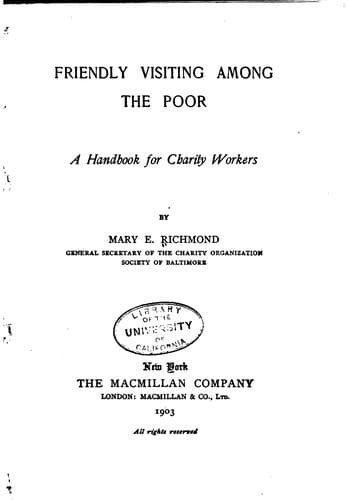
Friendly Visiting among the Poor: A Handbook for Charity WorkersRichmond, Mary Ellen
General
Friendly Visiting among the Poor: A Handbook for Charity Workers
Richmond, Mary Ellen
Friendly visiting
Nor will the pessimistic theory that the worker must spend as much as
possible on indifferent food and housing in order to keep up the rate
of wages, bear the light of common sense. It is true that the man who
merely hoards for the sake of hoarding, developing no new and higher
wants, no clearly defined aims, will still be almost as helpless as the
most thriftless. But no one is more helpless against the encroachments
of employers than the man who lives from hand to mouth, whose
necessities press ever hard upon him, crippling him and crippling those
{110} with whom he competes in the open market. Then again, successful
cooperation is impossible to the thriftless. The lack of self-control,
the lack of power to defer their pleasures, unfits them for combined
effort and makes it more difficult for them to be loyal to their
fellow-workmen. Visitors can advocate thrift, therefore, for both
economic and moral reasons.
There is a use of the word "thrift" that may help us to realize its
best meaning. Gardeners call a plant of vigorous growth a "thrifty"
plant. Let us bear this in mind in our charitable work, and remember
that anything that hinders vigorous growth is essentially unthrifty.
Thrift means something more than the hoarding of small savings. In
fact, saving at the expense of health, or training, or some other
necessary preparation for successful living, is always unthrifty. It
is unthrifty to live in damp rooms to secure cheaper rent; it is
unthrifty to put aside money for burial insurance when the children are
underfed; it is unthrifty either to buy patent medicines or to neglect
early symptoms of disease in order to save a doctor's bill; above all,
it {111} is unthrifty to take young children away from school and force
them to become breadwinners. Thrift, therefore, includes spending as
well as saving.
Charity workers often complain that, in the poor families known to
them, thrift is impossible, because there is nothing to save. More
often than not this means that their relations with the poor have
ceased as soon as acute distress is past, and that they have stopped
visiting at the very time when improved material conditions have made
the best friendly services possible.
Public-domain text, read in full here on John Shaqi.
Reviews
Reviews
No reviews yet
Be the first to share your thoughts on this work.
Join the Discussion
Join the discussion
Sign in to leave a comment or review.
Sign InorCreate an account