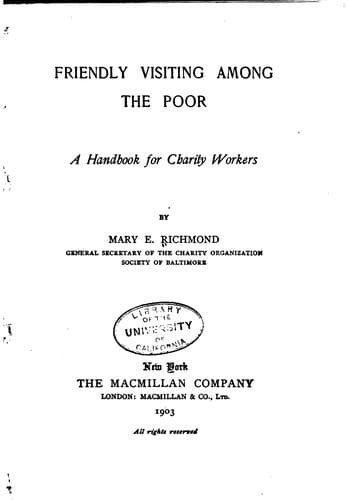
Friendly Visiting among the Poor: A Handbook for Charity WorkersRichmond, Mary Ellen
General
Friendly Visiting among the Poor: A Handbook for Charity Workers
Richmond, Mary Ellen
Friendly visiting
To enter into a discussion of the merits of industrial insurance, as
furnished in this country to the poor, is outside the scope of this
book, and the matter is treated quite fully, moreover, in another
volume of this series ("The Development of Thrift," by Mary Willcox
Brown), but the most enthusiastic advocates of industrial insurance can
hardly claim for it that it is an inexpensive form of saving. A very
large percentage of industrial policies lapse, and it is a common thing
to find that those who have kept up their payments and have {121}
become beneficiaries, spend everything on the funeral of the insured.
"Of $200.00 insurance received by one widow, $180.00 was given to the
undertaker, and the remaining $20.00 was expended for a mourning outfit
for herself. The family were being aided by the Emergency Society at
that time." [6] In New York, the agents of the Charity Organization
Society regard the following as a typical instance: A woman's husband
was insured for $136.00. When he died, she called the same undertaker
that had buried a child for them. His charges on the former occasion
had been moderate. The woman told him that she wanted a very
inexpensive funeral with only one carriage. This was the only
instruction that she gave. The undertaker asked whether the deceased
was insured, and was told that he was, whereupon he offered to collect
the insurance and to pay over to the widow what was left. His bill
amounted to $102.50. These instances do not indicate any collusion, of
course, between the undertakers and the insurance companies.
{122}
We have seen in another chapter that sickness is one of the most
persistent causes of distress, and only in rare instances does a death
occur that has not been preceded by weeks and often months of sickness.
The poor man needs sick benefits more than burial or life insurance,
and the children of the poor stand in need of many other things besides
decent burial. In fact, the money spent in child insurance, which can
be of no possible benefit to the child, is often needed to protect the
child's health or provide for its education. These should be a
parent's first care from no sordid motive, and yet it is a legitimate
view to regard children as an investment. The poor man has a right to
expect support from his children when he is no longer able to work, and
to neglect their best interests is to cripple his own future.
The beneficial societies and fraternal orders furnish a means of saving
for sick benefits, but they are of such varying degrees of merit and
trustworthiness that it is impossible to recommend them without
qualification. They have not gained the same position that the {123}
friendly societies hold in England, partly, perhaps, because they are
not subject in America to the same legal restrictions and official
inspection.
Public-domain text, read in full here on John Shaqi.
Reviews
Reviews
No reviews yet
Be the first to share your thoughts on this work.
Elsewhere in the archive
Join the Discussion
Join the discussion
Sign in to leave a comment or review.
Sign InorCreate an account