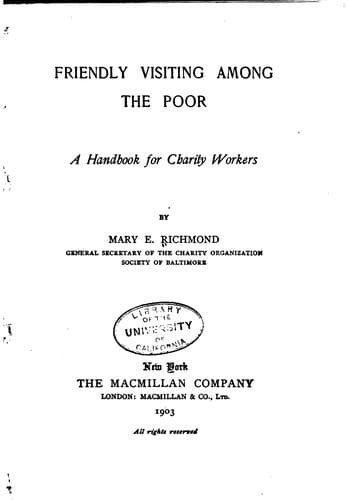
Friendly Visiting among the Poor: A Handbook for Charity WorkersRichmond, Mary Ellen
General
Friendly Visiting among the Poor: A Handbook for Charity Workers
Richmond, Mary Ellen
Friendly visiting
This new interest taken by philanthropy in the poor man as borrower is
still in the tentative and experimental stage, but there is an
encouraging analogy between its beginnings and the early history of the
savings banks. "It is seldom remembered," says Mrs. Lowell, "that the
great scheme of savings banks was originally conceived and put into
operation as a means of helping the poor. The two first {119} savings
banks were started in Hamburg in 1778, and in Berne in 1787, and both
were more or less closely restricted to the use of domestic servants,
handicraftsmen and the like. The Hamburg bank was part of the general
administration of the poor funds." [4]
When the poor man attempts to save, what inducements have greatest
weight with him? First of all, he is likely to save for some definite
and immediate object, because he cannot spend in any effective way
until he has saved. In teaching shiftless families to put by small
sums, therefore, it is well to keep some definite object in view. For
instance, persuade the children to save to buy needed clothing, or the
parents to save to buy proper clothing, bedding, etc., for the
children. This strengthens family affection and leads the way to a
bank account later, by showing what money can do.[5]
Next to such immediate inducements to thrift comes the dread of pauper
burial, which is a far more influential motive with the poor than the
dread of either dependence or privation. {120} Respectability is
measured in poor neighborhoods by funerals, and, whether the
neighborhood standards of morality and respectability are ours or not,
we cannot afford, in our charity work, to ignore them. Extravagant
funerals are an evil, and we should use our influence to discourage
extravagance, even where it is rooted quite as much in affection as in
vanity; but an unsympathetic attitude on the part of the charitable, an
inability to understand the neighborhood point of view, has helped to
encourage an extravagant form of saving, namely, burial and child
insurance.
Public-domain text, read in full here on John Shaqi.
Reviews
Reviews
No reviews yet
Be the first to share your thoughts on this work.
Elsewhere in the archive
Join the Discussion
Join the discussion
Sign in to leave a comment or review.
Sign InorCreate an account