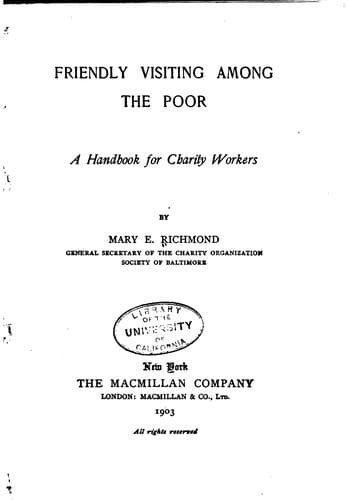
Friendly Visiting among the Poor: A Handbook for Charity WorkersRichmond, Mary Ellen
General
Friendly Visiting among the Poor: A Handbook for Charity Workers
Richmond, Mary Ellen
Friendly visiting
After all has been said in objection to past {175} and present methods
of church charity, we must realize that, if the poor are to be
effectually helped by charity, the inspiration must come from the
church. The church has always been and will continue to be the chief
source of charitable energy; and I believe that, to an increasing
degree, the church will be the leader in charitable experiment and in
the extension of the scope of charitable endeavor. In the church or
nowhere we must find acceptance for the methods advocated in this book.
In the church or nowhere we must seek the organized devotion that shall
protect the children of the poor from greed and neglect, that shall
advance sanitary and educational reforms, that shall supply purer and
higher amusements for the people, and shall bring to them more and
more, as time goes on, of the advantages of modern life. The church
has already been the pioneer in such work. In cities where
kindergartens are now a part of the public school system, the first
free kindergartens were supported by the churches, and large charities,
now secularized, were supported by {176} churches until they had passed
the stage of experiment. Secular agencies are still dependent upon the
churches for workers that can bring the right spirit to charitable work.
Instead of multiplying agencies needlessly, the city churches will find
it to the advantage of their spiritual work to keep up vital connection
with city charities. A clergyman who has an active church in one of
our eastern cities, has abandoned the plan of starting separate church
schools, societies, or institutions, realizing that many of these are
unnecessary, and that many others, necessary in themselves, are
inadequately supported. His people are sent instead, according to
their aptitudes, to hospitals, children's charities, societies for
visiting the needy, alms-houses, and homes for the aged. It may be
objected that the shoulder-to-shoulder contact, the strength of
concentration, is lacking in such a plan. But the church holds
frequent congregational meetings, where all who have been detailed to
serve as friendly visitors, hospital workers, etc., report to the
church and to the minister. Each one learns in {177} this way from the
work of the others; weak points in the city's plans for dealing with
the poor are made apparent; and the church is able by united effort to
obtain needed reforms. The work is understood to be a practical
application of the gospel as taught from the church pulpit, and there
is a natural and vital connection between the spiritual and social life
of the church community. Two other advantages are apparent. The
elasticity of the plan makes it possible to find work adapted to many
varying capacities, and all denominational rivalry, all petty jealousy
is avoided.
Public-domain text, read in full here on John Shaqi.
Reviews
Reviews
No reviews yet
Be the first to share your thoughts on this work.
Elsewhere in the archive
Join the Discussion
Join the discussion
Sign in to leave a comment or review.
Sign InorCreate an account