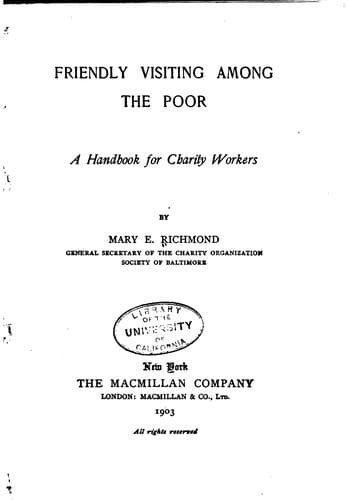
Friendly Visiting among the Poor: A Handbook for Charity WorkersRichmond, Mary Ellen
General
Friendly Visiting among the Poor: A Handbook for Charity Workers
Richmond, Mary Ellen
Friendly visiting
3. Gathering facts about the poor without making any effort to use
these facts for their good has been compared to harrowing the ground
without sowing the seed. The facts should be made the basis of a
well-considered plan. It may be necessary to modify our plans often,
as circumstances change or new facts are discovered; but a plan of
treatment {190} is as indispensable to the charity worker as to the
physician. Our plans must not ignore the family resources for
self-help. The best charity work develops these resources. If outside
help is needed, it should be made conditional upon renewed efforts at
work or in school, upon willingness to receive training, upon
cleanliness, or upon some other development within the family that will
aid in their uplifting. All this is suggested, not with a view to
making the conditions of relief difficult, but with a view to using
relief as a lever; or, as some one has put it, we should make our help
a ladder rather than a crutch, and every sensible, reasonable condition
is a round in the ladder.
Our plans for the benefit of one family must not ignore the possible
effects of our action upon other families. This is a hard lesson to
learn, but a plan that might be kind and effective, if there were only
one poor family in the city, is often unfair and even cruel, because it
rouses hopes in others which can never be fulfilled. In other words,
we must be just as well as merciful. A {191} knowledge of the
neighborhood and of the circumstances of other poor families is
necessary in judging of the justice of a plan, and here the criticism
and advice of an experienced charity worker will be very helpful.
It is necessary also to guard against making our plans with reference
to nothing but the present emergency. We must have a view to the
future of the family, and must think not only of what will put them out
of immediate need, but of what is most likely to make them permanently
self-supporting, if this be possible. There are, of course, families
that can never be made entirely self-supporting. These, if we consider
only the cases for which it is thought best to provide outside of
institutions, will be the exceptions; but in making plans for the
welfare of such families we must try to organize help that shall be as
regular and systematic as possible. Next to having to depend upon
charitable resources at all, the most demoralizing thing is to be
dependent upon uncertain and spasmodic charity.
Public-domain text, read in full here on John Shaqi.
Reviews
Reviews
No reviews yet
Be the first to share your thoughts on this work.
Elsewhere in the archive
Join the Discussion
Join the discussion
Sign in to leave a comment or review.
Sign InorCreate an account